Fading Resistant Outdoor Fabric Guide 2026
Last Updated: October 25, 2026
Quick Summary
Fading resistant outdoor fabric is upholstery textile engineered to hold its color through years of ultraviolet exposure, moisture, and abrasion. Read the rating, the test method, and the warranty as three separate documents, because colorfastness to light and abrasion resistance measure different things. Solution-dyed acrylic holds color best in sustained sun since pigment runs through the entire fiber.
- Colorfastness to light is scored on a 1-to-5 scale where 5 means negligible change.
- Most fade warranties cover sunlight color loss, not chlorine, mildew, or improper cleaning.
- Olefin absorbs essentially no water, making it the best of the four fibers for mildew resistance.
- Treat anything above roughly four to six hours of direct summer sun as high exposure.
- Rinse cushions monthly with a garden hose and never machine dry outdoor fabric.
Table of Contents
- How to Read Fade-Resistance Claims on Outdoor Fabric
- Solution-Dyed Acrylic Outdoor Fabric and Why It Holds Color
- Fiber-by-Fiber: Acrylic, Olefin, Polyester, and Spun Polyester Compared
- The Best Fabric for Outdoor Furniture Covers and Cushions
- Sunbrella Alternatives That Still Resist Fading
- Outdoor Fabric Care and Maintenance That Extends Color Life
- Matching Fabric to Your Climate, Exposure, and Furniture Set
- Shop Fade-Resistant Seating Built for Sun Exposure
- Frequently Asked Questions
How to Read Fade-Resistance Claims on Outdoor Fabric
Fading resistant outdoor fabric is upholstery textile engineered to hold its color through years of ultraviolet exposure, moisture, and abrasion. The chemistry matters less than the test data behind the label, and that is where most buyers get lost. We field the same question repeatedly: how do you tell a genuine performance claim from marketing copy? The answer is to read the rating, the test method, and the warranty as three separate documents.
Test Methods Behind the Ratings
Two lab tests dominate the category, and they measure different things. Colorfastness to light grades how much a swatch shifts after controlled ultraviolet exposure, usually scored on a 1-to-5 scale where 5 means negligible change. Abrasion resistance uses a rub tester, with results reported in double rubs. A fabric can score well on one and poorly on the other. For a broader look at the traps to watch for, see our guide to avoiding cheap patio furniture pitfalls.
What Warranties Actually Cover
Most fade warranties cover color loss from sunlight, not from chlorine, mildew, or improper cleaning. Read three clauses: the coverage period, the exclusion list, and whether the remedy is replacement or a prorated credit. A five-year warranty that excludes poolside exposure is worth less than a three-year warranty with no such carve-out. Keep your receipt. Nearly every claim requires proof of purchase and original care compliance.
| Claim Type | What It Measures | What to Ask |
|---|---|---|
| Colorfastness rating | Color shift after UV exposure | Which test, which lab? |
| Double rub count | Surface abrasion tolerance | Tested before or after weathering? |
| Fade warranty | Manufacturer remedy | Exclusions and proration terms |
| Water repellency | Surface beading behavior | Does it survive cleaning? |
Solution-Dyed Acrylic Outdoor Fabric and Why It Holds Color
Solution-dyed acrylic is fiber colored before it is spun, so pigment runs through the entire strand rather than sitting on the surface. That single manufacturing difference explains why the material resists fading where surface-dyed fabrics fail.
The practical consequence shows up in year three or four, not month one. Two cushions can look identical on delivery day and diverge sharply after two summers.
Fiber-by-Fiber: Acrylic, Olefin, Polyester, and Spun Polyester Compared
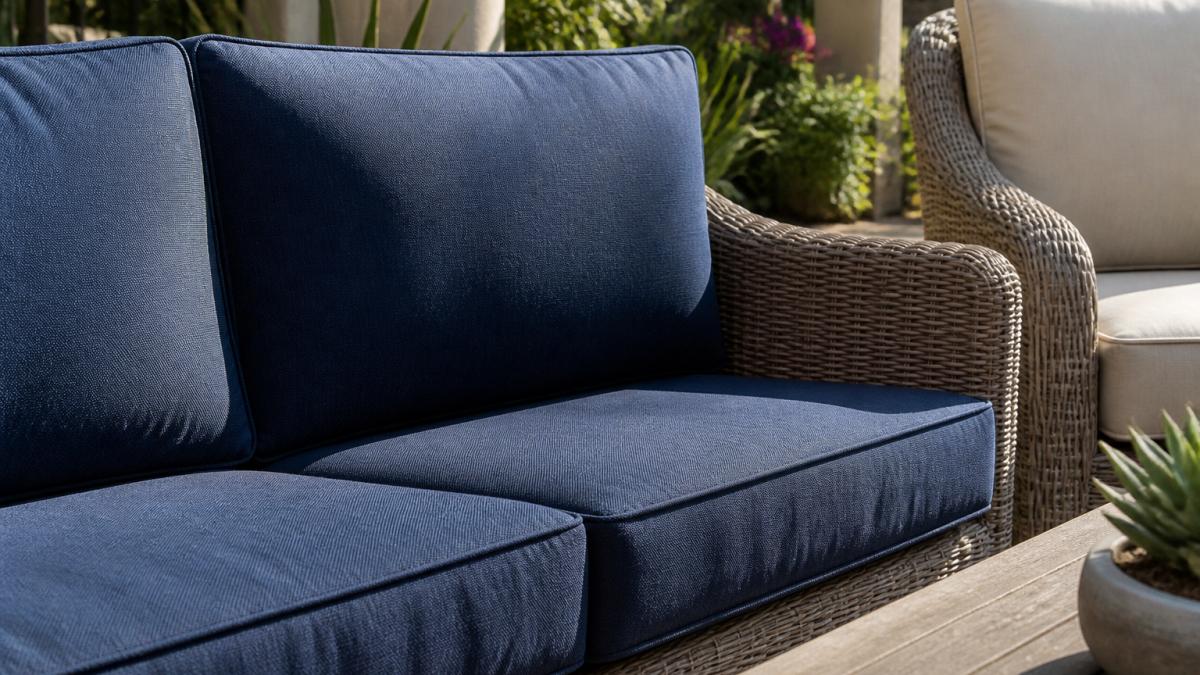
No fiber wins on every axis. The useful comparison is not "which is best" but "which trade-off fits this piece, this exposure, and this budget." Below is how the four fibers most common in outdoor upholstery actually behave, with the mechanisms that explain the differences.
Solution-dyed acrylic
- Color retention: The strongest of the group in sustained sun. Because the pigment is compounded into the fiber before extrusion, there is no surface dye layer to erode under UV. Color loss tends to be gradual and uniform rather than patchy.
- Hand and comfort: Soft, with a natural drape that reads closer to indoor upholstery than most outdoor fabrics. That matters on seating you actually sit on for hours.
- Moisture and mildew: Good, but not the leader. Acrylic absorbs very little water and dries reasonably fast, yet a tight weave with a breathable backing still matters more than the fiber alone.
Olefin (polypropylene)
- Color retention: Strong, especially when solution-dyed, which is the norm for outdoor olefin. UV performance is good but generally a step behind acrylic in relentless sun.
- Moisture and mildew: The best of the group. Olefin absorbs essentially no water, so it resists mildew and dries fast, a genuine advantage in humid, rainy, or coastal conditions.
- Hand and comfort: Coarser and slightly slicker than acrylic. Fine for covers, slings, and budget-to-mid cushions; less plush against skin.
Polyester (filament)
- Color retention: Moderate. Standard polyester is typically piece-dyed, so surface pigment can fade under strong UV. Solution-dyed polyester narrows the gap considerably, ask which you are buying.
- Abrasion: Excellent. Polyester is the toughness leader of the group, which is why it shows up in high-traffic seating and in blends.
- Moisture: Good water resistance and quick drying, though not quite olefin's level.
Spun polyester
- Color retention: Trails solution-dyed acrylic in harsh sun, particularly in saturated darks and brights. In shade or seasonal use the difference may take years to show.
- Hand and comfort: Softer than filament polyester, with better drape, the reason it appears in cushions where feel matters more than maximum UV life.
- Abrasion and moisture: Solid, similar to filament polyester.
Blends and the fine print
Many outdoor fabrics are blends, acrylic/polyester is common, and the blend ratio drives both price and performance. A blend can be a smart compromise, but the spec sheet should state the ratio and whether each component is solution-dyed. If it does not, treat the fade claim with caution.
A common mistake is assuming the most expensive fiber wins everywhere. It does not. The right question is which trade-off, color life, hand feel, moisture behavior, abrasion, or cost, your piece can least afford to lose.
The Best Fabric for Outdoor Furniture Covers and Cushions
The best fabric for outdoor furniture covers balances water repellency with breathability, because a cover that traps moisture does more damage than no cover at all.
If you are choosing a full set rather than replacing covers, our weather resistant outdoor sofa sets buying guide walks through how fabric choice ties into frame material and cushion construction. Fabric is one decision inside a larger one.
Sunbrella Alternatives That Still Resist Fading
Sunbrella dominates the conversation, but several mills produce solution-dyed acrylic and high-performance olefin blends that hold color credibly. When comparing alternatives, ignore brand names and check four things: whether the fiber is solution-dyed, the colorfastness rating, the warranty length, and whether the fabric passes a water repellency test after cleaning.
Watch out: some sellers advertise "acrylic" without specifying solution-dyed, which is a materially different product at a similar price. Ask for the construction spec in writing.
Outdoor Fabric Care and Maintenance That Extends Color Life
Regular cleaning does more for color life than any single product. Dust and pollen sit on the weave and hold heat and moisture against the fibers. Rinse cushions monthly with a garden hose, use a mild soap solution for spots, and let everything air dry fully before replacing cushions on frames.
Store cushions in a dry, ventilated space during off-season months rather than sealing them in plastic, which traps condensation. Rotate seat cushions periodically so sun exposure distributes evenly across the set.
Matching Fabric to Your Climate, Exposure, and Furniture Set
Lab ratings tell you how a swatch behaved in a controlled chamber. Your patio is not a controlled chamber. The gap between the two is where most fade disappointment happens, so this section translates test performance into what you can realistically expect by climate and exposure.
Start with exposure hours, not geography
Two homes in the same city can put wildly different UV loads on the same cushion. A covered porch that catches two hours of low-angle morning sun is a fundamentally different environment from an open pool deck under eight hours of direct afternoon sun. Before you shop, estimate:
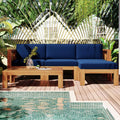
5-Piece Outdoor Patio Wood Sectional Sofa Set With Cushions →
- Direct sun hours per day on the piece in summer.
- Time of day, afternoon sun is more intense than morning sun at the same duration.
- Shade source, a pergola, awning, or tree canopy filters UV differently than a solid roof.
A rough working rule most practitioners use: treat anything above roughly four to six hours of direct summer sun as "high exposure" and spec accordingly. Below that, mid-tier fabrics often hold up fine for years.
What the ratings do and do not predict
A colorfastness-to-light rating describes color shift after a defined period of controlled UV exposure. It is useful for comparing fabrics tested the same way, but it does not tell you:
- How many real summers that translates to in your yard.
- How the fabric behaves under combined UV, moisture, heat, and abrasion.
- Whether the dye is on the surface or through the fiber.
Use ratings to rank candidates, then use fiber construction and warranty terms to make the final call. A high rating on a piece-dyed fabric is still a surface-dye bet.
Climate-by-climate guidance
Intense sun and heat (arid Southwest, high-altitude sun). UV load is the dominant stress.
Humid and rainy (Southeast, Gulf Coast). Moisture and mildew rival UV as the color-life threat.
Coastal salt air. Salt residue plus UV accelerates surface degradation.
Four-season and mixed climates. Off-season storage and rotation matter as much as fiber choice.
Shaded and covered spaces. Polyester and spun polyester can perform well for years here, and the acrylic premium buys less.
Seasonal and use-pattern adjustments
- Rotate seat cushions so sun exposure distributes across the set rather than concentrating on one or two seats.
- Store or cover during the harshest weeks if you are away, a cover that breathes beats a tarp that traps condensation.
- Reassess after year two. If you see uneven fading, it usually points to exposure pattern, not a defective fabric.
Exposure hours matter as much as geography. A covered patio gets a fraction of the UV load of an open pool deck, which changes the calculus entirely. For readers matching fabric to a hot, sunny yard, our guide to the best patio furniture for sunny climates pairs fabric recommendations with frame and set choices.
Shop Fade-Resistant Seating Built for Sun Exposure
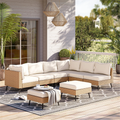
If you would rather buy the finished piece than spec the fabric, our 7-piece all-weather rattan patio sofa set with cushions and 5-piece outdoor patio wood sectional sofa set with cushions both ship with water-resistant, UV-resistant cushions built for sustained sun. Both are modular, so you can reconfigure seating as your space changes.


Frequently Asked Questions
Which outdoor fabrics resist fading in direct sunlight?
Solution-dyed acrylic holds color longest in direct sun because the pigment runs through the whole fiber rather than sitting on the surface. Solution-dyed olefin performs well at a lower price. Standard polyester and spun polyester fade fastest under intense ultraviolet exposure, though solution-dyed versions narrow the gap. Whatever the fiber, ask for the colorfastness rating and the exposure hours behind it, not just the word fade-resistant on the label.
Is solution-dyed acrylic better than polyester for outdoor cushions?
For sun-heavy patios, yes. Solution-dyed acrylic outdoor fabric keeps its color through years of ultraviolet exposure and resists moisture and mildew. Polyester costs less and feels softer, but piece-dyed polyester shows visible fading within a season or two in strong sun. If your cushions sit under a covered pergola or on a shaded porch, a quality polyester can work. In full afternoon sun, acrylic is the safer long-term buy.
What is the best fabric for outdoor furniture covers?
Look for a woven fabric with UV resistance, water repellency, and breathability so trapped moisture can escape. Solution-dyed acrylic and solution-dyed olefin are the two strongest choices for covers that face year-round weather. Avoid non-breathable plastic sheeting, which traps condensation against the furniture. A breathable cover with a water-repellent finish protects the frame and cushions without creating a mildew problem underneath.
What fabric is like Sunbrella but cheaper?
Solution-dyed olefin and solution-dyed polyester are the closest lower-cost alternatives. Olefin resists moisture, dries quickly, and handles sun well, though it can feel less soft against skin. Solution-dyed polyester sits between standard polyester and acrylic on fade resistance. Expect shorter warranty terms than premium acrylic brands offer. Compare the colorfastness rating and warranty length side by side rather than the marketing name.
How can I keep outdoor fabric from fading?
Shade is the biggest lever. A pergola, umbrella, or covered porch cuts ultraviolet exposure before it reaches the fabric. Rotate cushions so one side does not take all the sun, rinse off dust and pollen monthly, and clean spills before they set. Store or cover cushions during the harshest midday hours in peak summer. These habits slow fading on any fiber, and they matter most on south- and west-facing patios.
How long does outdoor fabric typically last in the sun?
Solution-dyed acrylic commonly carries warranties in the range of five to ten years against fading, and real-world life depends on exposure hours and climate. Fabrics in full sun in hot, dry regions age faster than the same fabric under a cover or in milder summers. Standard polyester may show noticeable color loss in one to three seasons of direct sun. Check the warranty's exposure assumptions before you count on the number.
Fabric that fades in two summers is a cost you pay twice. Oasis Patio Direct stocks seating built around weather-resistant materials, with free shipping on orders over $100 and a 30-day risk-free trial so you can see how a set holds up in your own yard before committing. Explore the collection and turn your patio into a space that still looks right after the season turns.