Built-In Gas vs Charcoal Grills for Outdoor Kitchens
Quick Summary
Built-in gas grills heat up in minutes, hold steady temperatures and are easy to control, making them better for frequent cooking. Built-in charcoal grills take more work to light and clean but deliver the smoky, char-rich flavor many cooks prefer. Choose based on how often you cook and whether smoke flavor or convenience matters more.
- Gas grills light with a push of a button and reach cooking heat in minutes.
- Charcoal produces a smoky, char-rich flavor that many cooks enjoy.
- Gas grills give repeatable heat, with separate zones across the burners on many units.
- Built-in charcoal grills need ash removal after cooking, so a removable ash tray helps.
- Confirm the fuel type and cutout spec from the manual before framing the cabinet.
Table of Contents
- Built-In Gas vs Charcoal Grills: The Core Trade-Off
- Gas vs Charcoal Grill Taste and Smoke Flavor
- Installation, Fuel Connections and Ventilation in a Built-In Island
- Heat Control, Searing and Cooking Versatility
- Built-In Charcoal Grill for Outdoor Kitchen: Ash, Cleanup and Upkeep
- Gas vs Charcoal Grill Health Considerations and Pellet Grill Alternatives
- Total Cost of Ownership and Choosing the Right Built-In Grill for Your Kitchen
- Frequently Asked Questions
Built-In Gas vs Charcoal Grills: The Core Trade-Off
Built-in gas grills and charcoal grills both belong in a well-planned outdoor kitchen, but they reward different cooks. Gas is typically faster, steadier and easier to control. Charcoal offers a hands-on cooking experience and a smoke flavor many cooks prefer. Choosing between them comes down to how you cook, how often you cook, and what your island can support.
Gas grills run on propane or natural gas, so they light with a push of a button and reach cooking heat in minutes. Built-in charcoal grills require a fire to be built, managed and cleaned out after each session. That extra work is the trade-off for the smoke and searing character many grillers prefer.
Many homeowners weigh one question first: do you want convenience on weeknights, or ritual on weekends? Answer that first, and the rest of the decision gets much simpler.
Gas vs Charcoal Grill Taste and Smoke Flavor
Charcoal produces a smoky, char-rich flavor that many cooks enjoy. Fat dripping onto hot lump charcoal creates smoke that clings to meat, and the flavor is hard to replicate without an open flame.
Gas grills produce a cleaner, more neutral taste. Juices and fat drip onto flavorizer bars or ceramic briquettes rather than burning fuel, so the food tastes more like the meat and seasoning. Many cooks like that clean profile, especially for fish, vegetables and delicate proteins.
If you want smoke, you can add wood chips to a gas grill, but results vary. For the most consistent smoke flavor, a charcoal model with a good airflow setup is the more reliable choice.
Installation, Fuel Connections and Ventilation in a Built-In Island
A built-in grill is a permanent appliance, so the island has to be designed around it rather than the other way around. Choosing cabinets that will house the grill and last outdoors is worth planning before framing begins. The details that decide whether an installation works, cutout dimensions, clearances to combustible material, ventilation, utility connections and access for service, matter for any built-in unit. Here is what to plan for with each fuel type.
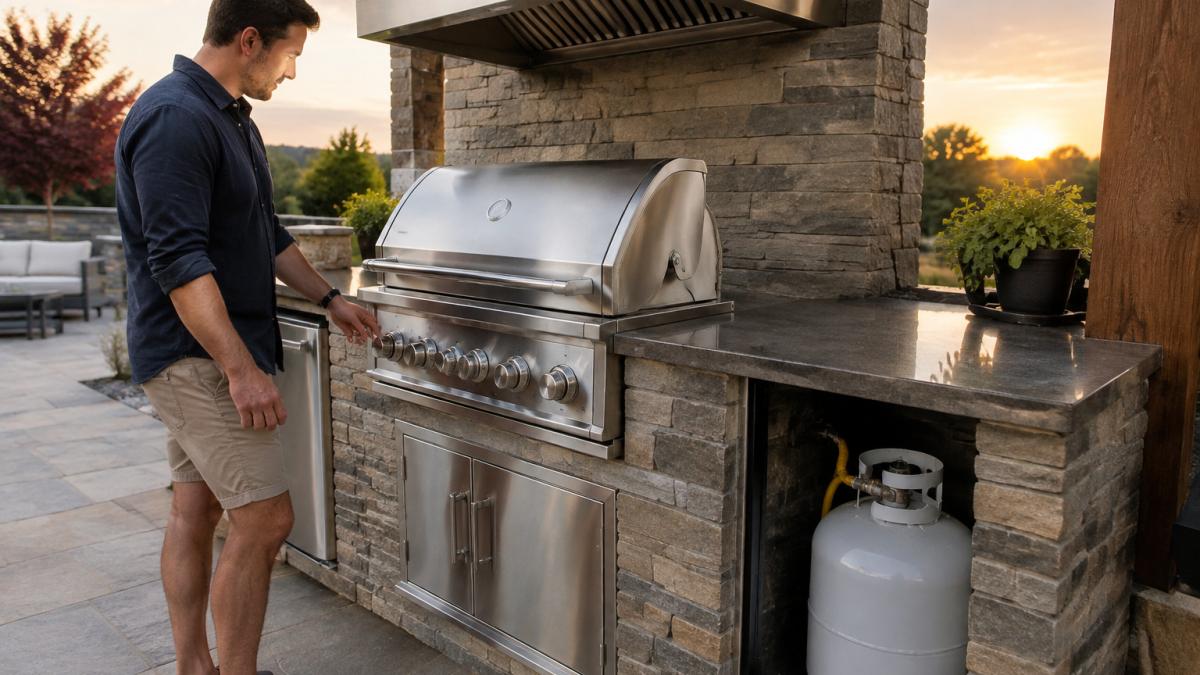
Gas: cutout, clearances and connections. A built-in gas grill drops into a cutout sized to the manufacturer's spec, and the spec is not interchangeable between models. The cutout width, depth and height, plus the required clearance to combustible surfaces behind and beside the unit, come from the owner's manual, not from the cart dimensions of a similar freestanding grill. Most manufacturers require a non-combustible surround (masonry, stainless, or a listed insulated jacket) when the island frame is wood or composite, and many require an insulated liner or jacket for built-in heads installed in combustible cabinets.
Gas supply is the second fixed decision. Natural gas requires a fixed line, usually run by a licensed plumber or gas fitter, with a shutoff valve accessible at the island and a sediment trap or drip leg per local code. Propane requires a tank or cylinder with its own clearance and ventilation rules, cylinders must not be stored in a sealed cabinet, and the cabinet that houses the cylinder needs ventilation at the low point because propane is heavier than air.
Charcoal: ventilation, ash and smoke path. A built-in charcoal grill changes the ventilation picture because the fuel itself produces smoke, ash and radiant heat. The island needs an opening or vented panel so air can feed the fire and heat can escape the cabinet, and the hood or chimney has to carry smoke up and away from the cooking area rather than into a covered patio or toward a wall. Ash management is a design problem, not just a cleaning problem: plan a removable ash tray or pan that can be pulled without dismantling the island, and keep a metal container for cooled ash nearby.
Access panels and service. Every built-in grill needs a way to reach the gas connection, regulator, and any electrical component without cutting the countertop. An access door or panel in the cabinet below the grill is standard practice for gas, and it also gives you a place to store the propane cylinder on some designs. Leave room behind and beside the unit for the hood to open fully and for the lid to clear a backsplash or wall.
For a gas unit, the KoKoMo 26-Inch Premium 45K BTU Elite 3-Burner Built-In Gas Grill suits a compact island, and the KoKoMo 32-Inch Premium 45K BTU Elite 4-Burner Built-In Gas Grill offers more cooking surface.
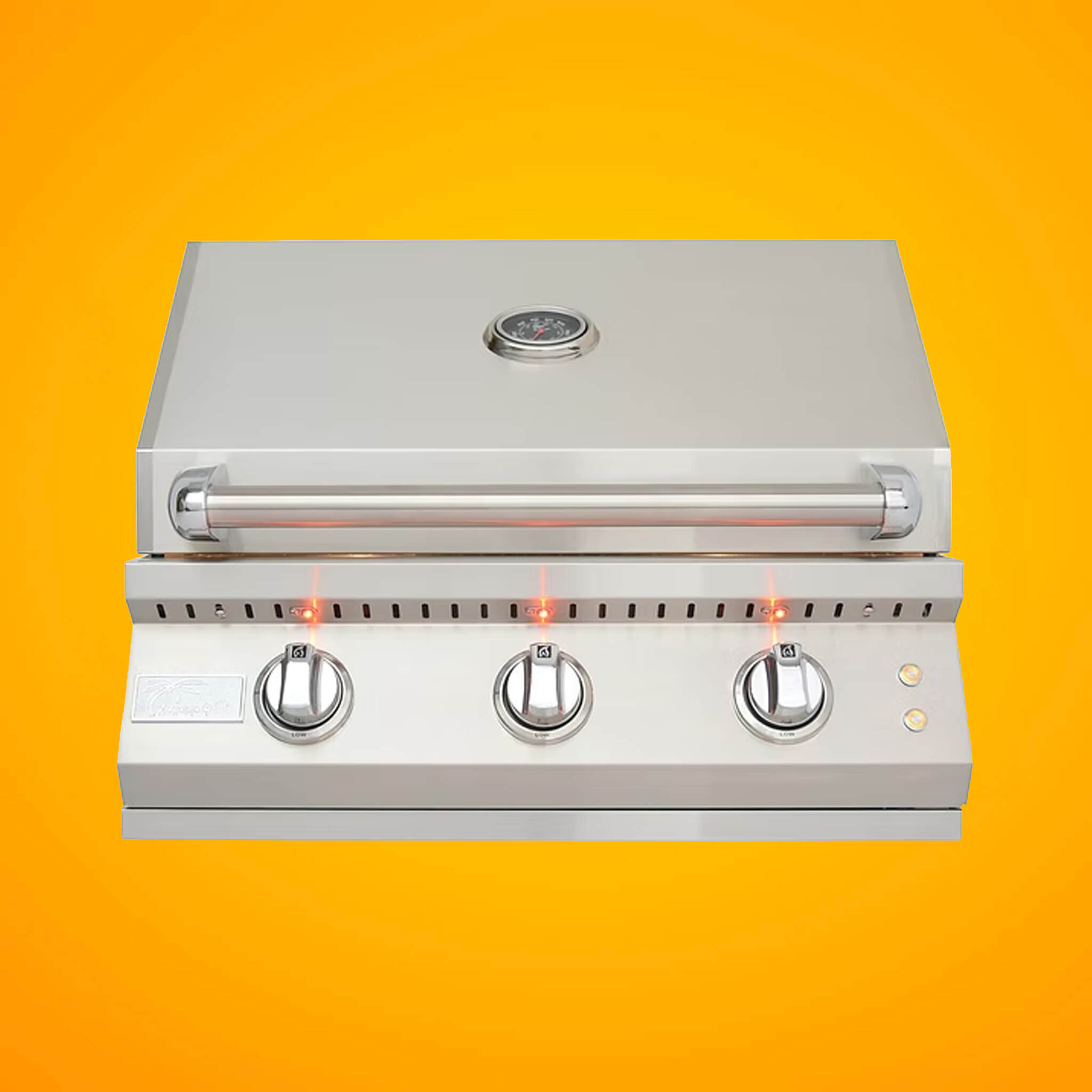
Watch out: Confirm the fuel type and the cutout spec from the manual before the cabinet is framed.
Heat Control, Searing and Cooking Versatility
Gas grills generally give you repeatable heat. Turn a knob to move from high-heat searing to low, indirect cooking, and many units let you run separate heat zones across the burners.
Charcoal reaches higher temperatures for a hard sear, but you control heat by adjusting vents and moving the coals. That takes practice. Once you master it, charcoal offers real flexibility for slow cooking and smoking.
The KoKoMo 32-Inch Premium 72K BTU Professional 4-Burner Built-In Gas Grill is listed with a 72,000 BTU output and a warming rack, which suits cooks who entertain often.
Built-In Charcoal Grill for Outdoor Kitchen: Ash, Cleanup and Upkeep
Charcoal cleanup involves removing ash after cooking. Ash must be removed from the firebox, and grease needs to drain without causing flare-ups. Built-in models with a removable charcoal tray make that job much easier than fixed designs. A removable tray is one practical detail to weigh alongside fuel choice and cooking needs when planning an outdoor kitchen with Kingdom Paver.
The KoKoMo Grills 32-Inch Premium Built-In Charcoal Grill With 304 Stainless Steel And Adjustable Heat Tray is built from 304 stainless steel and includes adjustable air dampers and a movable charcoal tray. Its listing also describes a double-walled hood.
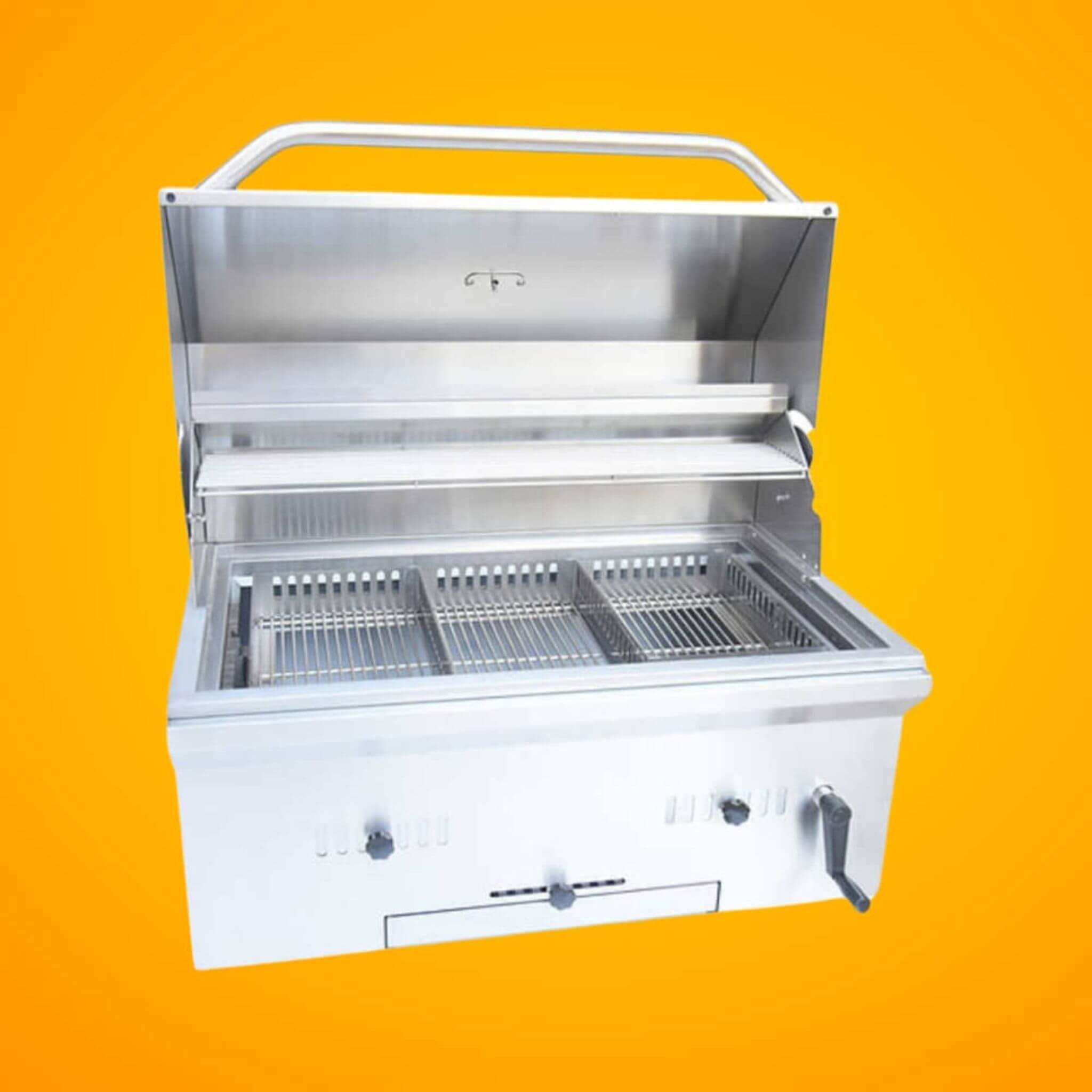
Plan for ash disposal in your island design, and keep a metal container nearby for cooled ash. Store charcoal in a dry place, since moisture makes it hard to light.
Gas vs Charcoal Grill Health Considerations and Pellet Grill Alternatives
Health questions around grilling usually focus on high-heat cooking and smoke.
For the health details of cooking methods, consult official resources such as the USDA Food Safety and Inspection Service guidance on safe grilling.
Total Cost of Ownership and Choosing the Right Built-In Grill for Your Kitchen
Upfront price is only the first line of the budget. Why a stainless steel outdoor refrigerator is worth it covers another major same-topic outdoor appliance investment. For a built-in grill, the total cost of ownership is the appliance plus the island work plus fuel plus accessories plus maintenance plus eventual replacement, and the two fuel types load those costs very differently. Most comparisons stop at the sticker price; this one does not.
Appliance and installation. Listed prices from Oasis Patio Direct: the KoKoMo 26-Inch Elite 3-Burner gas grill is $1,799.97, the 32-Inch Elite 4-Burner gas grill is $1,999.97, the 32-Inch Professional 72K BTU 4-Burner gas grill is $2,499.97, the 40-Inch Professional 5-Burner gas grill is $2,499.97, and the 32-Inch Premium Charcoal Grill is $2,099.97. Those are appliance costs only.
Fuel. Gas is metered or bought by the cylinder, and fuel costs can be easier to predict than charcoal costs. Charcoal is bought by the bag, and consumption depends on how long and how hot you cook; long low-and-slow sessions burn through more fuel than a quick weeknight sear. Neither fuel is free, but the pattern most cooks notice is that gas spreads its cost across many short sessions while charcoal concentrates cost in fewer, longer ones.
Accessories and consumables. Gas grills typically need a cover, a propane cylinder or two, and replacement flavorizer bars or briquettes over time. Charcoal grills need a chimney starter, a metal ash container, a cover, and a steady supply of charcoal and wood chunks. Budget for both as recurring costs, not one-time purchases.
Maintenance and durability. Stainless steel construction, 304-grade in particular, is the main lever on longevity for either fuel type, and it is worth paying for in a permanent installation because replacing a built-in head means reopening the island. Gas burners, igniters and regulators are wear items; charcoal fireboxes, grates and ash trays are the parts that corrode first. A double-walled hood and a removable charcoal tray on a charcoal unit extend service life by reducing heat stress and making cleanup easier.
Replacement. A built-in grill is replaced into the same cutout, so buying to a standard cutout size and a common fuel configuration makes the next replacement simpler. That is a real ownership cost most buyers ignore until the first swap.
Choosing. Choose gas if you cook often, want quick startup and consistent results, and value low cleanup, the lower per-session fuel cost and simpler daily routine usually win for weeknight cooks. Choose charcoal if smoke flavor and the ritual of cooking matter most and you are willing to trade time and fuel for character. The KoKoMo 32-Inch Premium 45K BTU Elite 4-Burner Built-In Gas Grill is a option to consider for entertainers who want cooking space and heat control. If you love charcoal, start with the KoKoMo Grills 32-Inch Premium Built-In Charcoal Grill With 304 Stainless Steel And Adjustable Heat Tray.
The article lists these prices and cost categories for each grill type, so the key figures can be compared at a glance.
| Item | Value | Note |
|---|---|---|
| KoKoMo 26-Inch Elite 3-Burner gas grill | $1,799.97 | Appliance cost only |
| KoKoMo 32-Inch Elite 4-Burner gas grill | $1,999.97 | Appliance cost only |
| KoKoMo 32-Inch Professional 72K BTU gas grill | $2,499.97 | Appliance cost only |
| KoKoMo 40-Inch Professional 5-Burner gas grill | $2,499.97 | Appliance cost only |
| KoKoMo 32-Inch Premium Charcoal Grill | $2,099.97 | Appliance cost only |
| Gas fuel | Metered or by cylinder | Costs spread across many short sessions |
| Charcoal fuel | Bought by the bag | Costs concentrate in longer sessions |
Frequently Asked Questions
Is it better to get a charcoal grill or a gas grill for an outdoor kitchen?
For most homeowners who cook several times a week, a built-in gas grill is the more practical choice. Gas lights quickly, holds steady temperatures and needs little cleanup, which suits frequent weeknight cooking and entertaining. Charcoal rewards hands-on cooks who want smoke flavor and high searing heat, but it takes longer to start, needs ash removal and requires proper ventilation in an enclosed island. Choose based on how often you cook and how much attention you want to give the fire.
Can you use a built-in charcoal grill in an outdoor kitchen?
Yes. The KoKoMo Grills 32-Inch Premium Built-In Charcoal Grill is made from 304 stainless steel and includes adjustable air dampers and a movable charcoal tray for heat control. Plan the island so the firebox has clearance from combustible materials and the hood can vent smoke. Keep an ash-disposal routine, since charcoal produces more ash and smoke than gas and a built-in unit must be cleaned between cooks.
Which grill gives food a better flavor, gas or charcoal?
Charcoal produces a distinct smoky flavor from burning fuel and drippings, which many cooks prefer for steaks, ribs and brisket. Gas produces a cleaner taste that lets the food and seasoning stand out, and it can add flavor through smoker boxes or wood chips. The difference is most noticeable in slow cooks and in seared meats. If smoke flavor is a priority, charcoal is the better match; if you want consistent results with less effort, gas is the stronger choice.
Are gas grills easier to maintain than charcoal grills?
Generally, yes. Gas grills produce no ash to remove after each use. Charcoal grills, including the built-in charcoal model from KoKoMo Grills, still require you to empty ash and clean grates after cooking. Both types benefit from periodic burner or firebox cleaning and a protective cover when not in use.
Listed appliance prices for built-in grills