Why a Stainless Steel Outdoor Refrigerator Is Worth It
Last Updated: November 7, 2026
Quick Summary
A stainless steel outdoor refrigerator is a weather-rated cooling appliance built to sit in your outdoor kitchen year-round, keeping drinks and perishables steps from where people gather. It is engineered for temperature swings, moisture, and direct sun that an indoor unit is not designed for, so it avoids the condensation and shortened service life an indoor or garage unit may suffer on a patio.
- Look for an outdoor appliance rating on the label before you buy.
- Check whether the unit lists 304 or 316 stainless steel, especially near water.
- A solid stainless steel door holds temperature better than a glass door in full sun.
- Plan a dedicated, outdoor-rated circuit with GFCI protection installed by a licensed electrician.
- Compare the energy guide or rated power draw, not just the purchase price.
Table of Contents
- Why a Stainless Steel Outdoor Refrigerator Changes How You Host
- Outdoor-Rated vs. Indoor Refrigerator: What Actually Differs
- Stainless Steel Grades and Construction, Explained
- Best Outdoor Refrigerator Features to Check Before Buying
- Installation, Ventilation, and Electrical Requirements
- Outdoor Refrigerator Maintenance That Prevents Rust and Costly Repairs
- Total Cost of Ownership: Purchase Price vs. Long-Term Value
- Choose Your Outdoor Refrigerator at Oasis Patio Direct
- Frequently Asked Questions
Why a Stainless Steel Outdoor Refrigerator Changes How You Host
A stainless steel outdoor refrigerator is a weather-rated cooling appliance built to sit in your outdoor kitchen year-round, not a garage fridge you roll out for parties. A dedicated outdoor refrigerator changes how guests move through a backyard: drinks stop requiring trips inside, and the host stops playing waiter.
A common approach is to place the fridge within arm's reach of the grill and prep counter. That single decision removes the bottleneck at every gathering.
Consider what a dedicated unit can offer:
- Cold drinks and perishables stay steps from where people gather
- The kitchen door stops swinging open every ten minutes
- Food comes out at the right temperature instead of warming on a tray
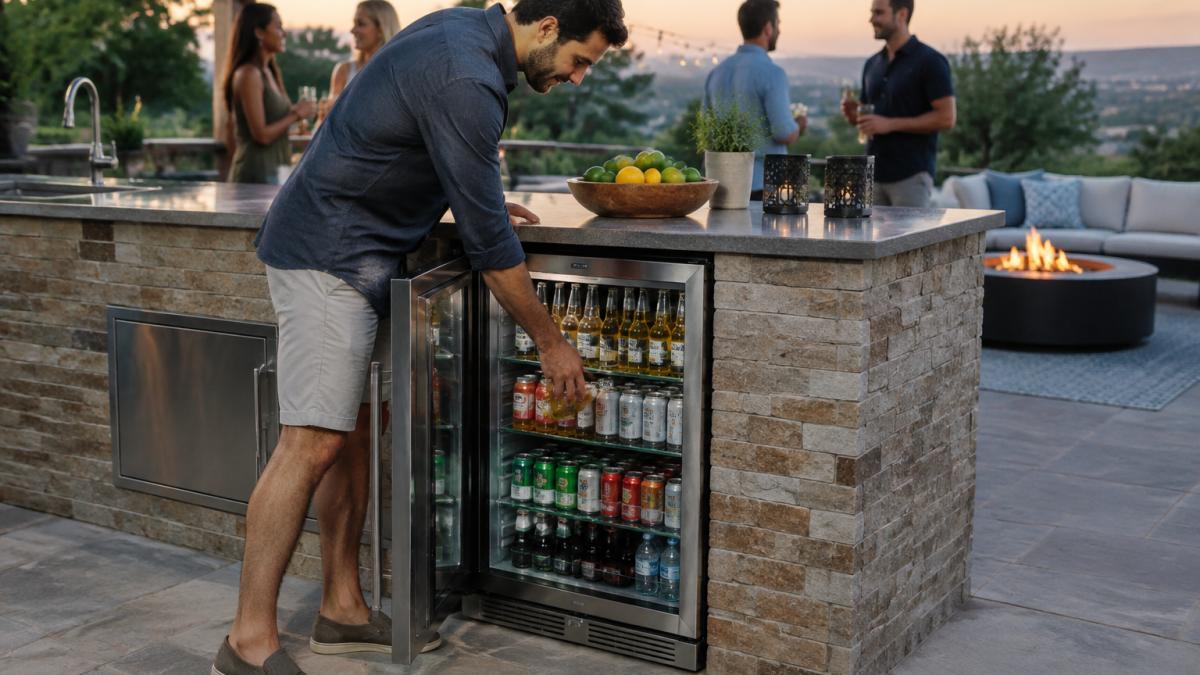
For readers picturing a complete setup, it helps to see how a full outdoor kitchen island with a built-in refrigerator fits together before committing to a layout.

Outdoor-Rated vs. Indoor Refrigerator: What Actually Differs
An outdoor-rated appliance is engineered for temperature swings, moisture, and direct sun that an indoor unit is not designed for. Indoor refrigerators are tested for stable room conditions; placed on a patio, they can work harder and suffer from condensation.
Watch out: an indoor or garage unit installed outdoors may cool fine in spring and struggle in July, which shortens its service life and puts food safety at risk. Look for an outdoor appliance rating on the label before you buy.
Stainless Steel Grades and Construction, Explained
Stainless steel resists rust because of the alloying elements in the steel itself. The grade and the construction details decide how well that resistance holds up in heat, humidity, rain, and salt air.
304 vs. 316 Stainless Steel
Stainless steel grade affects corrosion resistance, so it is worth checking the grade listed for any unit you consider, particularly if you live near the water.
Insulation, Door Type, and Compressor Placement
A solid stainless steel door holds temperature better than a glass door in full sun, though glass shows off your stock.
Best Outdoor Refrigerator Features to Check Before Buying
The best outdoor refrigerator features are the ones that survive daily use in the elements: a sealed, corrosion-resistant cabinet, dependable temperature control, and hardware that does not seize after a season of rain.
Here is how we would prioritize the checklist:
| Feature | Why It Matters | Priority |
|---|---|---|
| Outdoor appliance rating | Confirms the unit is built for weather | Must-have |
| 304 or 316 stainless steel | Resists rust and corrosion | Must-have |
| Digital temperature control | Keeps food at safe temperatures | Must-have |
| Solid stainless steel door | Better insulation in heat | Strongly preferred |
| Soft-close hinges | Prevents slamming, lasts longer | Nice to have |
| Interior LED lighting | Easy to find items at night | Nice to have |
Capacity and storage space come next. A 24-inch undercounter refrigerator offers a useful amount of storage for a gathering.
Installation, Ventilation, and Electrical Requirements
Installation is an important part of getting reliable performance from an outdoor refrigerator. A unit that is correctly specified but boxed into a tight cabinet or plugged into a shared indoor circuit will underperform no matter how good the stainless steel is.
Ventilation Clearances
Refrigerators reject heat through the condenser, and outdoors that heat has nowhere to go if the cabinet is sealed. Most manufacturers publish a required clearance at the rear and sides, and the exact figure varies by model, so the label and manual are the authority. A common pattern in undercounter units is a gap of roughly one to two inches at the rear and a vented toe kick or louvered panel at the front so air can move across the condenser. Built-in units are designed to breathe through a front grille; freestanding units need open space on multiple sides.
Watch out: enclosing a freestanding refrigerator in a cabinet built for a built-in model is one of the most common installation mistakes, and it typically shows up as a compressor that runs constantly and a cabinet that never quite gets cold in summer.
Built-In vs. Freestanding
- Built-in: Sits flush in an island cutout, vents through a front grille, and requires the cutout dimensions in the manual to be followed precisely. Plan the cutout before the island is framed.
- Freestanding: Needs clearance on the sides and rear and takes floor space, but is easier to relocate and service.
- Undercounter: A built-in subtype sized for a counter-height opening; confirm door swing and hinge side against adjacent walls and grill cabinets.
Electrical Requirements
Plan a dedicated, outdoor-rated circuit with GFCI protection, installed by a licensed electrician and compliant with local code. Confirm the unit's voltage and amperage from the nameplate before the island is framed, because retrofitting conduit into a finished stone or masonry island is far more expensive than running it during the build. A GFCI receptacle in a weatherproof in-use cover is the standard arrangement for an outdoor kitchen; the cover matters because it keeps rain off the connection while the cord stays plugged in.
Placement, Sun, and Drainage
- Keep the unit out of direct afternoon sun where the layout allows; a shaded or covered run of counter reduces compressor load.
- Leave the manufacturer's specified gap at the rear and sides, and do not block the front grille with stored items.
- Provide drainage or a slope away from the base so standing water does not collect under the unit after rain.
- In coastal settings, position the unit so salt spray and wind-driven rain reach it as little as possible, and rinse the exterior periodically.
A simple pre-build checklist: confirm the model's cutout and clearance figures, confirm voltage and amperage, confirm the GFCI outlet location and cover, confirm door swing, and confirm the base drains. Getting those five items right before the island is built is the difference between an appliance that lasts and one that becomes a service call.
Outdoor Refrigerator Maintenance That Prevents Rust and Costly Repairs
Outdoor refrigerator maintenance is mostly about keeping surfaces clean and drains clear. Wipe the stainless exterior with a soft cloth and mild soap, rinse, and dry; avoid abrasive pads that scratch the protective finish.
A few habits extend the unit's life:
- Rinse and dry the door gasket so it does not grow mildew
- Clear debris from vents and the drain line each season
- Check the door seal by closing it on a piece of paper
- Cover or shelter the unit during long idle stretches
Corrosion resistance is built in, but it is not maintenance-free. Small scratches left to collect moisture are where rust typically starts.
Total Cost of Ownership: Purchase Price vs. Long-Term Value
Most outdoor refrigerator comparisons stop at the sticker price, which is the least useful number in the decision. Total cost of ownership adds electricity, maintenance, repairs, and replacement over the unit's service life, and it is the calculation that separates a bargain from a good buy.
The Four Cost Components
- Purchase price: The upfront number, and the only one most buyers compare.
- Energy use: A function of insulation quality, door type, ambient temperature, and how often the compressor cycles. A solid stainless steel door and thick insulation reduce run time; a glass door in full sun increases it.
- Maintenance: Gasket care, vent and drain clearing, and exterior cleaning. Low in dollars, but neglect is what shortens service life.
- Repairs and replacement: The wildcard. Parts availability and service access decide whether a failure is a repair or a replacement.
Why the Cheapest Unit Often Costs the Most
A lower-priced unit that fails in a few seasons usually costs more than a well-built one that runs for years, because the replacement resets the purchase price and the installation labor. That is a cost that shows up on the electricity bill every month and again as an early replacement.
How to Compare Two Units Fairly
- Compare the energy guide or rated power draw, not just the purchase price.
- Compare warranty length and what it actually covers, compressor vs. sealed system vs. parts and labor.
- Confirm parts availability and whether local service is realistic for an outdoor appliance.
- Estimate service life from construction: stainless grade, insulation, door type, and compressor placement.
Service Life, Warranty, and Repairability
Warranty coverage is part of the value equation, and the details matter more than the headline years. A warranty that covers the compressor but not labor still leaves a real bill when a repair is needed. Before buying, confirm what is covered, how long, and who performs the work. Repairability is the quieter factor: a unit with commonly available parts and accessible service panels is cheaper to keep running than one that must be replaced when a single component fails.
Value for money, then, is not the lowest price. It is the lowest total cost across the years you expect to own the unit, purchase price plus energy plus maintenance plus the realistic chance of repair or replacement. That is the calculation worth making before you commit to a layout.
Choose Your Outdoor Refrigerator at Oasis Patio Direct
When you are ready to buy, look at a unit built for the job. The Summerset 24-inch outdoor rated refrigerator offers 5 cubic feet of storage, digital temperature control, a soft-closing door, auto-defrost, and interior LED lighting, all in durable stainless steel with an anti-vibration system.

If your plans run larger, a six-burner island with a pizza oven and refrigerator shows how the appliance anchors a full entertaining setup.

The hardest part of an outdoor kitchen is choosing components that hold up season after season. Oasis Patio Direct stocks weather-resistant outdoor refrigerators and full kitchen islands built for exactly that, backed by free shipping on orders over $100 and a 30-day risk-free trial. Get started with Oasis Patio Direct and build a backyard that works as hard as you host.
Frequently Asked Questions
Can you use a regular refrigerator outside?
A standard indoor refrigerator is not built for outdoor conditions. Its compressor and controls are designed for stable indoor temperatures, and humidity, rain, and temperature swings can shorten its life and strain the cooling system. An outdoor-rated unit is sealed and tested for weather exposure, so it holds temperature in heat and resists corrosion. If the refrigerator will sit on a covered patio or in an outdoor kitchen, choose a model rated for outdoor use.
What is the best refrigerator for outdoors?
Look for a stainless steel outdoor refrigerator with an outdoor rating, digital temperature control, and a compressor designed for hot weather. Check the stainless grade (304 or 316), insulation quality, door seal, and ventilation clearance. A 24-inch undercounter model with about 5 cubic feet of storage, like the Summerset 24-Inch Outdoor Rated Refrigerator, fits most outdoor kitchens and includes anti-vibration protection, soft-close door, and auto-defrost.
How do you protect an outdoor refrigerator from weather?
Place it under a roof overhang, pergola, or in a built-in island with a countertop above it. Keep the vents clear so heat can escape, and avoid direct rain and sprinkler spray. Wipe the stainless steel exterior with a damp cloth and mild soap monthly, and rinse off salt or pollen buildup. During freezing spells, shut the unit off and follow the manufacturer's guidance for cold-weather storage.
Is an outdoor refrigerator worth the price?
For homeowners who host regularly, it usually is. A stainless steel outdoor refrigerator keeps drinks and ingredients within reach, cuts trips inside, and adds usable storage to the outdoor kitchen. Prices start around $2,329.97 for a 24-inch Summerset model at Oasis Patio Direct. Weigh that against years of use, the convenience of cold drinks on the patio, and the resale appeal of a complete outdoor kitchen.