Professional Backyard Design Service Options: 2026 Guide
Table of Contents
- The Main Professional Backyard Design Service Options Compared
- Landscape Designer vs. Landscape Architect: Which Credential Fits Your Backyard
- What Happens During a Backyard Design Consultation
- Online Landscape Design Plans: What You Get and Who They Suit
- Professional Backyard Design Cost, Broken Down Line by Line
- Deliverables, Ownership, and Contract Checks Before You Sign
- How to Choose a Provider for Your Specific Backyard
- Conclusion: Match the Service Model to Your Project
- Frequently Asked Questions
Last Updated: October 12, 2026
The Main Professional Backyard Design Service Options Compared
Choosing a professional backyard design service shapes everything that follows. At Oasis Patio Direct, homeowners weigh a full design-build firm against an independent designer or a downloadable plan, each delivering a different level of control, cost, and hand-holding.
Backyard design is the process of planning how an outdoor space will be laid out, built, and planted before any work begins.
The three service models below cover nearly every project. The right one depends less on budget than on how much you want to manage yourself.
| Service Model | Typical Deliverable | Best For | Your Involvement |
|---|---|---|---|
| Full-service design-build firm | Design plus construction under one contract | Whole-yard transformations | Low |
| Independent designer or architect | Plans, drawings, and specifications | Owners hiring their own contractor | Medium |
| Online plans and DIY packages | Scaled plan set and plant list | Confident do-it-yourselfers | High |
Full-Service Design-Build Firms
A design-build firm handles design and installation under one roof: a single point of contact, one contract, and one company accountable when something goes wrong.
The trade-off is cost and flexibility. These firms price the whole project, so you pay for coordination as well as labor. If you already have a contractor you trust, you may be paying twice for project management.
Independent Designers and Architects
An independent designer produces the plan and steps back. You hire the contractor, order materials, and manage the schedule.
This model suits owners who want to stay involved and control where the money goes. It also means you own the coordination risk. A plan that looks simple on paper can stall on site when nobody is managing the trades.
Online Landscape Design Plans and DIY Packages
Online plan services sell a scaled drawing and plant list after a short questionnaire and a few photos, professional guidance at a fraction of a custom design fee.
What you don't get is site-specific problem solving. Grading, drainage, and utility locations rarely show up in a photo, and those are exactly the issues that derail a build.
Landscape Designer vs. Landscape Architect: Which Credential Fits Your Backyard
The difference comes down to licensing and scope. A landscape architect is state-licensed to design structures and systems affecting public safety; a landscape designer handles planting, layout, and aesthetics without that license.
For most residential yards, a designer is enough: someone who can lay out a patio, choose plants for your light, and place a structure without crowding the house. That work rarely requires a license.
An architect earns their fee when the project involves grading, retaining walls, drainage engineering, or permits. The American Society of Landscape Architects outlines the scope of licensed practice if you want to check where your project falls.
Ask one question before you hire either: who stamps the drawings if the city requires it? The answer tells you whether you need the license.
What Happens During a Backyard Design Consultation
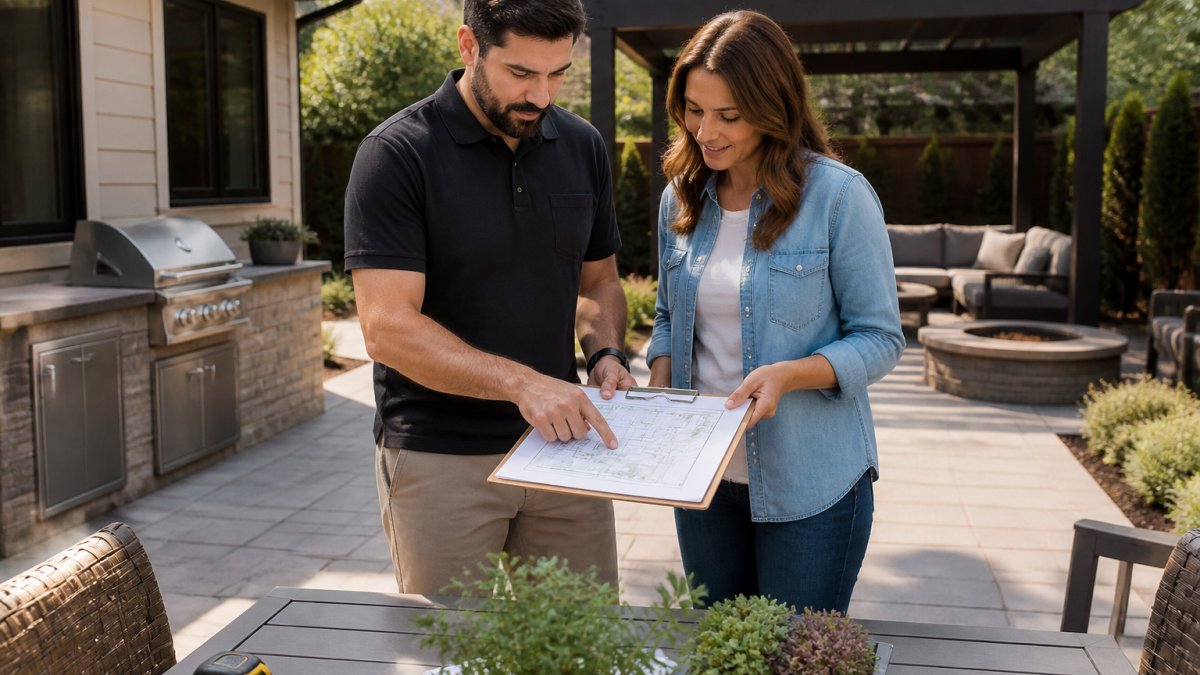
A backyard design consultation is a working session, not a sales pitch. The designer walks the yard, measures the space, notes sun and shade, and asks how you actually use it.
Expect one to two hours. Good designers ask more than they talk, about gatherings, pets or young children, and how much maintenance you'll tolerate.
What to Bring and What to Ask
Bring a survey or plot plan, photos of yards you like, and a rough budget range. Being upfront about money saves time.
Ask these questions before the meeting ends:
- What's included in the design fee, and what costs extra?
- How many revision rounds do I get?
- Who owns the drawings when we're done?
- Do you install, or do I hire someone?
- What's your timeline from plan to build?
That last question matters more than most expect: design takes a few weeks, and permitting and scheduling add considerably more.
Online Landscape Design Plans: What You Get and Who They Suit
An online landscape design plan is a remote service delivering a scaled layout, planting plan, and materials list from photos and measurements you supply, faster and cheaper than custom design.
These packages suit straightforward yards, a patio refresh, planting bed redesign, or small courtyard, but struggle with complicated sites.
If your yard slopes, floods, or has mature trees with aggressive roots, a remote plan won't catch what a site visit would. Use the online route when the layout is simple and you're comfortable making field decisions.
Professional Backyard Design Cost, Broken Down Line by Line
Backyard design cost breaks into four buckets: design fees, site preparation and hardscape, structures and furnishings, and long-term upkeep.
Design fees. Usually the smallest line.
Site preparation and hardscape. Where budgets move fastest. Excavation, grading, and clearing depend on what's underground, roots, rock, old footings, utility lines, and how much soil is hauled.
Structures and furnishings. The part you control most directly, since manufactured products carry fixed prices.
Long-term upkeep. The line most homeowners forget. Irrigation repairs, re-mulching, seasonal plant replacement, and structure maintenance recur yearly. A design cheap to install can be expensive to keep.
Where Structures Fit in the Budget
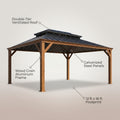
Structures are the easiest line to price in advance because they're manufactured, not site-built, predictability worth a lot when the rest of the budget is moving.
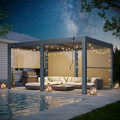
Aluminum Louvered Pergola, Outdoor Pergola with Adjustable Louvered Roof →
At Oasis Patio Direct, our aluminum louvered pergola runs $4,909 and assembles in two to three hours with three or four people.

For tighter spaces, the Verona cabana pergola is $2,189 and fits corners and compact patios where a full-size structure won't.
If shade control matters more than size, the retractable canopy pergola at $899.97 lets you adjust two canopy sections independently.
What Changes the Total
A few variables move a backyard budget most:
- Access. If equipment can't reach the yard, everything is hand-carried, and labor climbs.
- Slope. A flat yard is cheap to work with. A sloped yard needs grading, terracing, or retaining walls, each with its own engineering and material cost.
- Drainage. Poor drainage turns a simple patio into a drainage project before the patio starts.
- Permits and engineering. Retaining walls over a certain height, structures with footings, and anything touching a property line often require stamped drawings and a permit.
- Phasing. Building in stages spreads cost but adds mobilization charges each time a crew returns.
Deliverables, Ownership, and Contract Checks Before You Sign
The deliverable list is the most negotiated and least read part of a design contract. Know exactly what you're getting before money changes hands.
A complete package typically includes a scaled site plan, a planting plan with species and sizes, a materials list, and construction details. Lighting layouts and irrigation zones may be included or charged separately.
Ownership is the trap.
Before signing, confirm four things:
- The full deliverable list, in writing
- Who owns the drawings after final payment
- Proof of insurance and any required state licensing
- A payment schedule tied to milestones, not dates
Ask for a certificate of insurance directly from the carrier. A photocopy of a policy from three years ago tells you nothing.
How to Choose a Provider for Your Specific Backyard
Matching the provider to the yard matters more than matching price.
Work through the constraints in order. The first one that applies usually determines the provider type.
**1.
**2.
**3.
4. How much do you want to manage? If you want one company accountable for everything, hire design-build.
5. What's your budget shape? A fixed budget favors manufactured structures and standard materials; a flexible one can absorb site-built features and custom masonry.
6. How big is the yard? Small yards reward designers who make compact plans feel generous; large yards reward firms with crews and equipment to move material efficiently.
Questions That Separate Providers
Once you've narrowed the model, test the provider in the consultation:
- Ask them to walk the yard and name the two biggest risks they see. A good provider names drainage, access, or grade. A weak one names style.
- Ask what they'd do differently if the budget were cut by a third. The answer shows whether they design to a number or design and then price.
- Ask for two recent projects of similar size and complexity, and ask whether you can see them.
- Ask who will be on site day to day, and whether that person is an employee or a subcontractor.
Check reviews on the specific service you're buying, not the company overall. A firm with excellent construction reviews may have a slow design team, and a great planting designer may hand off construction details poorly.
Conclusion: Match the Service Model to Your Project
The hardest part of a backyard renovation isn't picking a style, it's choosing who does the work and how much you take on yourself. Get that right and the rest follows.
If you're ready to anchor your project with a structure you can price today, Oasis Patio Direct offers weather-resistant pergolas and gazebos built for year-round use, with a 30-day risk-free trial and free shipping on orders over $100. Our louvered and retractable designs let you control shade through every season, and they assemble with basic tools in an afternoon.
Explore the Collection and start with the piece that defines your outdoor room.
Frequently Asked Questions
What is the difference between a landscape designer and a landscape architect?
Landscape architects hold state licenses and can stamp construction documents for structural work like retaining walls, grading, and drainage engineering. Landscape designers focus on planting plans, layout, and aesthetics without that licensing. For a typical residential backyard with hardscape and plantings, a designer often covers the scope. If your project involves significant grade changes, structural features, or permit drawings, you may need an architect. Some states restrict who can use the title, so confirm credentials before hiring.
How much does professional backyard design cost?
Costs vary widely by service model. Full-service design-build firms typically fold design fees into the overall project, with design alone often running several thousand dollars depending on scope. Independent designers may charge hourly or a flat fee per plan. Online landscape design plans are usually the least expensive option, often a few hundred dollars for a custom plan. Itemized budgets should separate design fees, permits, site preparation, hardscape, planting, and structures so you can see where the money goes.
Should I hire a designer or a design-build company?
A design-build firm handles design and installation under one contract, which simplifies coordination and accountability. Hiring a designer separately gives you more control over bidding the installation to multiple contractors, which can save money but adds management work on your end. If you want a single point of contact and a faster timeline, design-build is often the smoother path. If you want to compare installation bids or plan to install some elements yourself, a standalone designer or online plan may serve you better.
Can I buy my own pergola and still work with a designer?
Yes. Many homeowners use a designer for the overall layout, planting plan, and hardscape, then purchase structures like pergolas directly. This works well when you already know the footprint and style you want. For example, an aluminum louvered pergola with an adjustable roof gives you control over shade and airflow, and a cedar gazebo pergola with an arched roof adds a focal point without custom fabrication. Share the exact dimensions and anchoring requirements with your designer so the plan accounts for footings and clearances.