Modern Pergola Designs for Small Backyards: 2026 Guide
Table of Contents
- Modern Pergola Designs for Small Backyards: Quick Comparison
- Louvered Roof Systems: The Best Shade Control for Tight Spaces
- Small Backyard Pergola Kits: What to Look For
- How to Anchor a Pergola on Concrete: A Step-by-Step Guide
- Cost of Installing a Small Pergola: Budget Breakdown
- Structural Engineering for Small Footprints: What Most Guides Miss
- Smart Home Integration and Seasonal Transitions
- Frequently Asked Questions
Last Updated: September 20, 2026
Modern Pergola Designs for Small Backyards: Quick Comparison
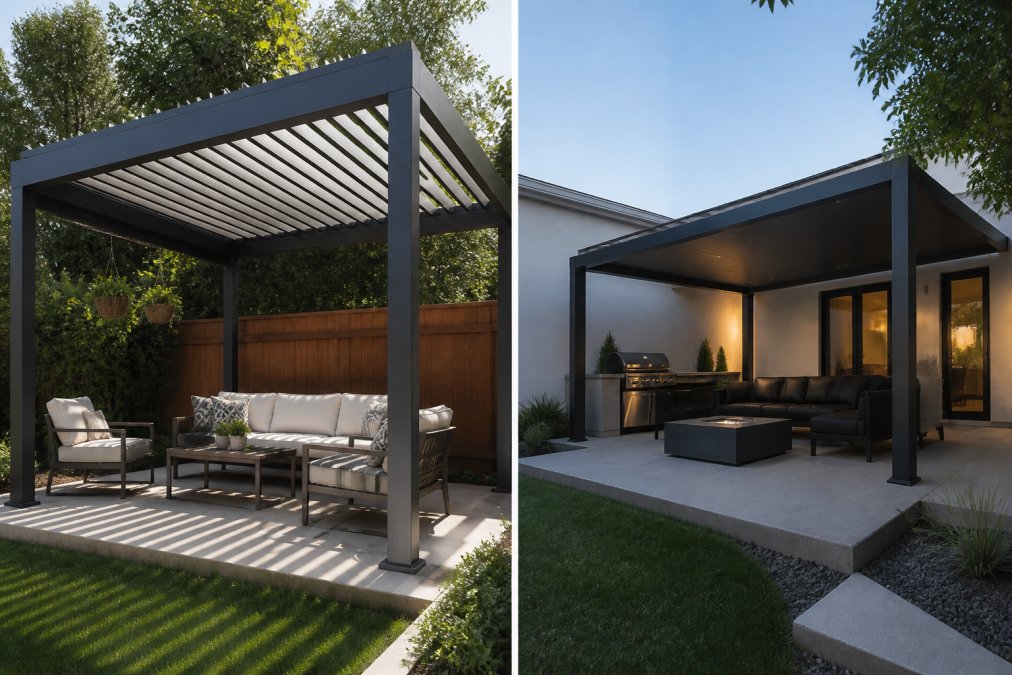
The best modern pergola designs for small backyards prioritize footprint efficiency over raw size. A louvered aluminum structure in the 8x8 to 10x13 foot range delivers full shade control without swallowing your remaining lawn.
| Design | Best For | Footprint Range | Shade Control | Typical Price |
|---|---|---|---|---|
| Louvered aluminum | Full sun, tight patios | 8x8 to 10x13 ft | Adjustable louvers | $1,599.97+ |
| Wood slatted | Natural look, vines | 8x8 to 10x12 ft | Fixed, partial | $1,299.97+ |
| Cabana corner | Awkward corners | 8x8 ft | Fixed canopy | $2,189.00 |
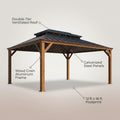
| Wood-grain aluminum | Wood look, low upkeep | 12x12 ft | Adjustable louvers | $4,999.97 |
| Screen-integrated | Privacy plus shade | 10x20 ft | Adjustable plus screens | $6,499.97 |
| Grape trellis | Living canopy | 9x12 ft | Grown foliage | $1,599.97 |
Louvered Roof Systems: The Best Shade Control for Tight Spaces
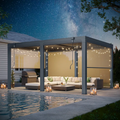
A louvered roof system is a pergola top of rotating slats that tilt to control sun exposure below. For small backyards, it solves the fixed roof's central problem: morning brightness and full 3 p.m. shade without a second structure. On a compact patio you cannot move furniture to chase shade, so adjustable louvers move the shade instead.
How Adjustable Louvers Maximize a Small Backyard Footprint
Adjustable louvers maximize a small footprint by changing shade level rather than structure size. One 10x13 foot pergola with rotating slats replaces two fixed structures: an open frame for cool months and a solid canopy for peak summer.
Small Backyard Pergola Kits: What to Look For
Small backyard pergola kits are prefabricated structures shipped with pre-drilled components, hardware, and instructions. Three factors separate a good kit from a frustrating one: material, anchoring method, and pre-assembly.

- Pre-drilled and pre-cut components. Misaligned holes are the single biggest cause of abandoned DIY builds.
- Included anchoring hardware. Expansion bolts should come in the box, not as a separate purchase.
- Stated wind rating. A number tells you what the structure was tested against. A vague "weather-resistant" claim tells you nothing.
- Assembly crew size. Most kits in this range need two to three people and several hours.
Aluminum vs. Wood vs. Steel: Material Trade-Offs for Small Spaces
Aluminum wins on maintenance, and wood on warmth.
| Material | Maintenance | Weight | Weather Behavior | Best For |
|---|---|---|---|---|
| Aluminum | Minimal | Light | Resists rust, fading | Humid or coastal yards |
| Cedar | Annual sealing | Moderate | Naturally decay-resistant | Natural aesthetic |
| Fir | Periodic treatment | Moderate | Needs paint protection | Budget wood builds |
| Steel | Touch-up painting | Heavy | Corrodes without coating | Rarely worth it |
For a small backyard, aluminum's lighter weight reduces load on a modest concrete pad. Cedar and fir bring warmth but need annual attention; wood-grain aluminum gets you both.
How to Anchor a Pergola on Concrete: A Step-by-Step Guide
Anchoring a pergola on concrete means drilling through the base plates into the slab and securing them with expansion bolts. The anchor system, not the frame, keeps it standing in a storm.
Tools and Materials You'll Need
- Hammer drill with a masonry bit matched to your bolt diameter
- Vacuum or compressed air for clearing dust from holes
- Expansion anchor bolts (usually included with the kit)
- Socket wrench and level
- Shims for uneven slabs
Step 1: Mark the base plate positions. Set the assembled frame in place and mark each bolt hole through the base plates.
Cost of Installing a Small Pergola: Budget Breakdown
The cost of installing a small pergola splits into four buckets: structure, foundation, permit, and labor or time you supply. Most homeowners budget for the first and get surprised by the other three.
| Line Item | Typical Range | What Drives the Number |
|---|---|---|
| Pergola kit (structure only) | $1,299.97 - $6,999.97 | Size, louver type, integrated lighting or screens |
| Anchoring hardware | $0 - $150 | Often included with the kit; confirm before ordering |
| Concrete pad or footing work | $400 - $3,500 | New pour vs. existing slab; 4-inch slab is the common minimum |
| Building permit | $0 - $500+ | Jurisdiction, valuation method, and whether the structure is attached |
| Electrician (if hardwiring lights) | $250 - $900 | Only if you skip plug-in LED strips |
| DIY assembly time | 4 - 12 hours | Two to three people for most kits in this range |
| Pro installation labor | $800 - $2,500 | Regional labor rates and site access |
The Permit Line Item Most Guides Skip
Permit cost is the most variable number in the table, and often avoidable. Most jurisdictions exempt detached, open-roof structures below a height threshold (commonly 6 to 8 feet) or a footprint threshold (often 100 to 120 square feet); an 8x8 or 8x10 pergola frequently lands under both. An attached pergola, or one with a solid or louvered roof that reads as covered, usually triggers a permit regardless of size.
- Is a detached, open-roof structure under 100 square feet exempt from a building permit?
- Does the exemption change if the structure is anchored to an existing slab versus set on new footings?
- Are there separate zoning setbacks I need to respect from the property line?
Where the Money Actually Goes
For a typical 10x13 louvered aluminum kit at mid-range price, the structure is roughly 60 to 75 percent of the all-in cost; the remaining 25 to 40 percent is foundation, permit, and labor. That ratio flips if you pour a new slab or hire an electrician, those two line items alone can exceed the gap between a budget kit and a premium one.
DIY vs. Professional Installation
DIY assembly on a small kit is realistic for two adults with basic tools and a free weekend. The anchoring step is the one most homeowners underestimate, a hammer drill, the correct masonry bit, and clean holes matter more than brute force. Professional installation adds $800 to $2,500 depending on region and site access, and is worth it if your slab is uneven, your property line is tight, or you want the permit paperwork handled.
local building permit requirements and fee schedules
[10X19FT] Modern Durable All-Weather →
Structural Engineering for Small Footprints: What Most Guides Miss
Small footprints change the engineering math. A compact pergola has less span to cover, but also less mass and fewer anchor points to resist wind uplift, which is why wind ratings matter more on a small structure, not less.
Three engineering points specific to tight spaces:
- Vertical clearance. Keep at least 7 feet of clearance under the lowest beam. Small patios tempt you to lower the roof for a cozier feel, but head clearance is not negotiable.
- Anchor spacing. Fewer posts mean each anchor carries more load. Spacing matters as much as bolt size.
- Drainage slope. On an integrated-drainage pergola, confirm the gutter path runs toward the posts, not toward your seating area.
Smart Home Integration and Seasonal Transitions
Smart home integration for pergolas is a growing area; many guides focus on basic lighting. For a small backyard, automate the three things you'd otherwise adjust daily, shade, light, and enclosure.
The Three Automations That Matter in a Small Space
Motorized louvers. A hand-crank works, but a motorized version lets you schedule shade by time of day or trigger it from a rain sensor. In a small yard where you cannot move furniture to chase shade, this is the highest-value automation. Look for a wall switch plus remote as baseline, app or voice control as the upgrade.
Seasonal Transition Strategy for a Fixed Footprint
Spring. Open louvers wide for airflow and inspect every anchor bolt after the last freeze-thaw cycle. Freeze-thaw is the leading cause of loose base plates, and a small structure has fewer anchors carrying more load each. Re-torque anything that has backed off.
The Removable-Shade-Sail Alternative
If you want a true seasonal transition without a permanent roof, a shade sail rigged over an open pergola frame gives you summer shade and winter sun with one piece of hardware. The trade-off is wind: a sail acts like a kite in a storm, so it has to come down before high winds. For a small yard wanting maximum winter sun, this is the cheapest seasonal strategy.
snow load and wind rating guidance for residential structures
Frequently Asked Questions
What are the best modern pergola designs for small backyards in 2026?
Louvered roof pergolas lead for small backyards because they combine shade control, rain drainage, and a low-profile design. Aluminum frame options with adjustable louvers and powder-coated finishes work well in tight spaces. Wood-grain aluminum offers the warmth of timber without the maintenance. Corner-shaped pergolas, like the Verona 8 ft. x 8 ft. cabana, fit awkward angles that rectangular structures cannot. Focus on footprint, material, and whether you need fixed or adjustable shade.
Are small backyard pergola kits easy to assemble without a contractor?
Most small backyard pergola kits are designed for DIY assembly with two to four people. Aluminum louvered kits often include pre-drilled holes, prefabricated rails, and all necessary hardware. Assembly times range from 2 to 6 hours depending on size and complexity. You will need basic tools like a drill, wrench, and level. If you are anchoring on concrete, you will also need a hammer drill and masonry bits. Hiring a contractor adds labor cost but saves time.
How much does it cost to install a small pergola on concrete?
The cost of installing a small pergola depends on the structure and whether you DIY or hire help. Oasis Patio Direct's Aluminum Louvered Pergola Kit starts at $1,599.97, while the Verona 8 ft. x 8 ft. wooden cabana pergola is $2,189.00. Professional installation typically adds several hundred to over a thousand dollars, depending on your area and the pergola's size. Anchoring hardware and concrete tools are often included or cost under $50. DIY saves the most if you have basic skills.
How do I anchor a pergola on concrete in a small backyard?
To anchor a pergola on concrete, position the base plates over your marked spots, then drill pilot holes through the concrete using a hammer drill and masonry bit. Insert expansion anchor bolts or wedge anchors and tighten them with a wrench. Some kits, like the Aluminum Louvered Pergola, include explosive bolts for quick installation. Ensure the concrete slab is at least 4 inches thick and in good condition. For high-wind areas, use larger anchors or consult a structural engineer.
What materials hold up best in hot, sunny climates?
Aluminum with a powder-coated finish resists rust, fading, and corrosion better than wood or steel in intense sun and heat. Galvanized steel louvers add strength without rusting. Cedar and fir wood can warp or fade without regular sealing, though cedar is naturally decay-resistant. For Arizona-like conditions, aluminum louvered pergolas with UV-resistant coatings are the most durable choice. They require minimal maintenance and keep their appearance through seasonal temperature swings.