How Do You Design a Luxury Outdoor Kitchen With a Pizza Oven?
Last Updated: November 2, 2026
Quick Summary
Start by measuring your space and checking the ground, then arrange the prep, cook and serve zones around the pizza oven. Choose built-in or freestanding ovens and weather-durable materials, and resolve clearances, ventilation, utilities and budget before committing to a luxury outdoor kitchen.
- Measure the patio and mark sun and wind direction before choosing a layout.
- Place the pizza oven away from doorways, windows and seating, with its opening facing away from prevailing wind.
- Leave at least 36 inches of walkway behind the cooking zone so two people can pass.
- Always follow the oven and grill manufacturer's published clearance to combustibles, which overrides rules of thumb.
- Budget for the whole project and include a 10 to 15 percent contingency.
Table of Contents
- Assessing Your Space and Site Suitability
- Outdoor Kitchen Layout Ideas That Work With a Pizza Oven
- Built-In Outdoor Pizza Oven Versus Freestanding: Choosing the Right Option
- Wood-Fired Versus Gas-Fired: Fuel, Performance and Oven Selection
- Outdoor Kitchen Materials for Luxury Finishes and Weather Durability
- Clearances, Ventilation, Utilities and Budget Planning
- Booking Your Design Plan and Choosing Your First Pieces
- Frequently Asked Questions
Assessing Your Space and Site Suitability
Designing a luxury outdoor kitchen with a pizza oven starts with one question: how much usable space do you actually have? Establishing these boundaries early ensures that your chosen luxury kitchen layout integrates seamlessly with the surrounding landscape while maintaining the necessary flow for professional-grade outdoor cooking.
Begin by mapping the area you can give up to cooking.
Check the ground as well. A level, load-bearing surface such as poured concrete or a compacted paver base handles a heavy stone-clad island far better than soft soil.
Walk the space while imagining guests, a cook and a server all moving at once. If that scene feels cramped, the site is too small for a true entertaining kitchen.
Outdoor Kitchen Layout Ideas That Work With a Pizza Oven
The most successful layouts treat the pizza oven as the focal point and build the work zones around it. Readers comparing fuel types can view a dual fuel gas or wood-fired pizza oven they can actually buy.

Keep the sequence logical: prep, cook, serve. Place the refrigerated drawer and sink near the prep counter, the grill and pizza oven in the middle, and the serving area at the far end where guests gather.
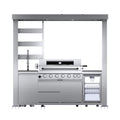
If you want a complete, ready-to-install solution, the 150-Inch 4-Burner 108K BTU Outdoor Kitchen Island With Pizza Oven, Rotisserie & Refrigerator is priced at $12,999.97 and brings the grill, pizza oven, rotisserie and refrigerator into one long run, which suits larger patios.

Pizza Oven Placement and Orientation
Place the pizza oven where it can be reached comfortably from the prep counter, but keep its opening facing away from prevailing wind so smoke and heat don't blow back toward the cook. Position the oven at a comfortable working height so the pizza peel doesn't require stooping.
Cooking, Prep and Movement Zones
Leave at least 36 inches of walkway behind the cooking zone so two people can pass without crowding the grill. Set the prep counter immediately beside the oven so ingredients never travel far. A common mistake is placing the serving table on the far side of the cooking station, which forces the cook to carry hot food through the crowd.
Built-In Outdoor Pizza Oven Versus Freestanding: Choosing the Right Option
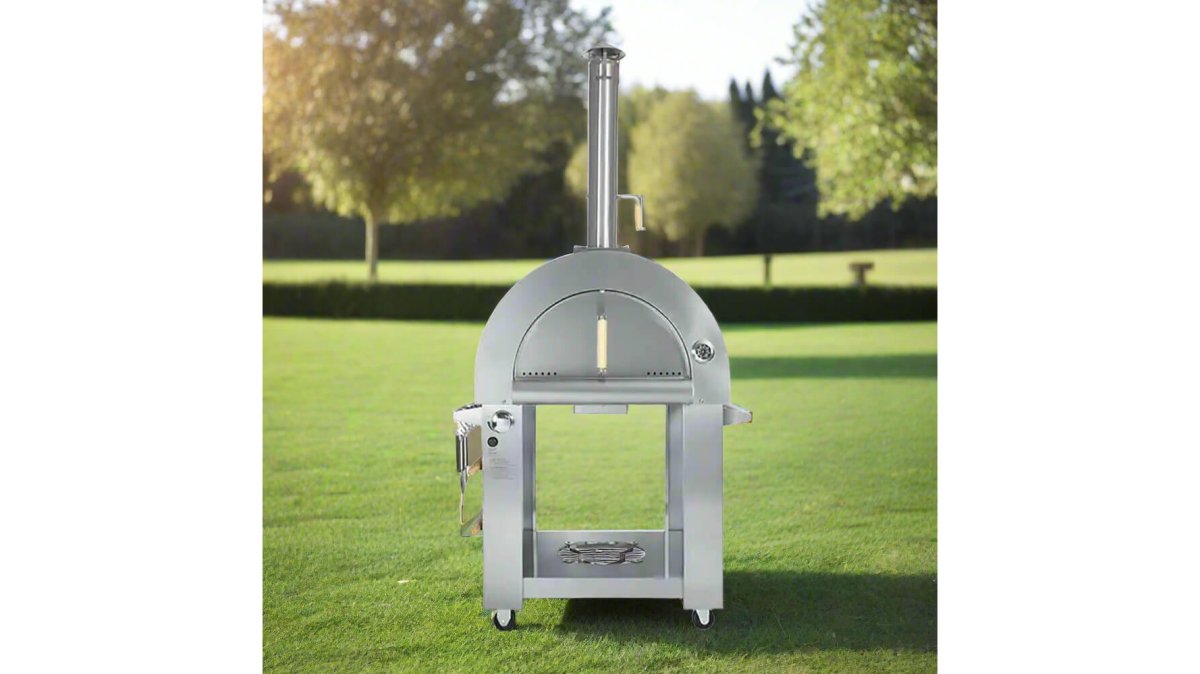
A built-in pizza oven becomes part of the island's masonry, giving a seamless, high-end look that matches stone and granite finishes. A freestanding model offers flexibility: you can move it, replace it, or place it on an existing patio without rebuilding anything. For a comparison, see a freestanding outdoor gas pizza oven.
Built-in ovens suit homeowners planning a permanent, architectural outdoor kitchen. Freestanding units suit renters, smaller budgets, or anyone who expects to reconfigure the space later.
Wood-Fired Versus Gas-Fired: Fuel, Performance and Oven Selection
A dual-fuel oven gives you both. The KoKoMo Grills Premium 32-Inch Stainless Steel Dual Fuel Gas Or Wood Fired Pizza Oven lets you switch between wood-fired and gas cooking, priced at $2,499.97.
Outdoor Kitchen Materials for Luxury Finishes and Weather Durability
Luxury in an outdoor kitchen is decided less by the appliances than by the surfaces guests touch. The materials you choose have to survive freeze-thaw cycles, UV exposure, salt air, and the radiant heat a pizza oven throws off, while still reading as a deliberate, high-end design. Treat this as a specification exercise, not a shopping list.
Countertops: match the surface to the heat and the climate
- Natural stone (granite, quartzite): Polished or honed slabs give the most architectural look and wipe clean easily.
- Sintered stone and porcelain slabs: These are increasingly specified for luxury outdoor kitchens because they resist UV fading, stains, and thermal shock, and they can be book-matched for a seamless look. They are lighter than thick stone, which matters for island framing.
- Concrete and cast-in-place tops: A troweled or precast concrete counter gives a monolithic, custom feel. The trade-off is weight and the need for a properly engineered base; hairline cracking is a common pattern in freeze-thaw climates.
Cabinetry and island cladding
For a luxury look, specify cabinet doors and drawer fronts in marine-grade 304 stainless steel, powder-coated aluminum, or a composite polymer built for exterior use. Wood-look porcelain tile and stacked stone veneer are popular cladding choices for the island face, but confirm that any combustible cladding stays outside the manufacturer's required clearance from the oven and grill. Soft-close stainless drawers, concealed hinges, and integrated pull-outs for a pizza peel and wood storage are the details that separate a custom build from a kit.
150-Inch 4-Burner 108K BTU Outdoor Kitchen Island With Pizza Oven, Rotisserie →
Detailing that signals luxury
- Edge profiles: A thick mitered edge (often 2 to 3 inches) on a stone or sintered top reads as premium; a standard 3/4-inch square edge reads as builder-grade.
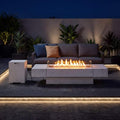
- Integrated lighting: Low-voltage LED strip lighting under the counter overhang and inside the pergola beams extends usable hours and highlights the stone. Specify exterior-rated fixtures and a GFCI-protected circuit.
- Hardware and accents: Match drawer pulls, towel bars, and vent covers in a single finish, brushed stainless, matte black, or bronze, so the kitchen reads as one composition.
Weather durability checklist
Specify materials rated for exterior use, confirm that fasteners are stainless rather than galvanized, slope countertops slightly away from the house so water sheds, and seal stone and concrete on a regular schedule.
Clearances, Ventilation, Utilities and Budget Planning
This is the section most inspiration-led guides skip, and it is where luxury projects succeed or stall. Before you commit to a layout, resolve four things: clearances, ventilation, utilities, and a realistic budget.
Clearances and heat protection
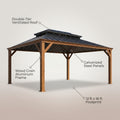
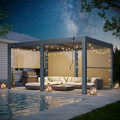
Always follow the oven and grill manufacturer's published clearance to combustibles, it overrides any rule of thumb. Non-combustible surrounds, stone, tile, stainless, or concrete board, belong directly behind and beside a wood-fired oven. A durable all-weather pergola with aluminum frame and steel louvers can shelter the cooking area while you plan these clearances. If your pergola or roof structure is wood, confirm the required clearance from the oven flue and consider a non-combustible heat shield.
Ventilation and chimney routing
A wood-fired oven needs a properly sized chimney that drafts reliably; a gas oven still needs ventilation for combustion byproducts and heat. Route the flue so it terminates above the roofline and away from windows and intake vents, and confirm the chimney height and cap requirements with the manufacturer. An outdoor kitchen enclosed by walls or a pergola on three sides needs more ventilation, not less.
Permits and code
Check with your local building and fire authorities before construction, since permit and licensing requirements vary by jurisdiction.
Utilities and infrastructure
- Gas: Confirm whether natural gas is available at the site or whether you will run propane. Size the line for the combined BTU load of the grill, oven, and any side burners.
- Electrical: Plan circuits for lighting, refrigeration, rotisserie motors, and any ignition systems. Outdoor receptacles need weatherproof covers and GFCI protection.
- Water and drainage: A sink requires a supply line and a drain; plan the drain slope and winterization before the slab is poured.
Budget bands to plan against
- Pizza oven: Freestanding gas and dual-fuel units commonly run from roughly $2,000 to $6,000; large built-in wood-fired ovens and premium brands can run well into five figures.
- Grill and appliances: A premium built-in grill, side burner, refrigerator, and rotisserie commonly add several thousand dollars on top of the oven.
- Island, cabinetry, and countertops: Custom masonry and stone work is often the largest single line item and scales with length and finish level.
Budget for the whole project, not just the appliances: foundation work, utility connections, countertops, cover structures and installation can add substantially to the cost of the kitchen itself.
The main cost drivers to plan for, as the article lays them out:
| Budget item | Typical cost or note | Planning point |
|---|---|---|
| Freestanding gas or dual-fuel pizza oven | Roughly $2,000 to $6,000 | Appliance price is only part of the total |
| Large built-in wood-fired or premium oven | Well into five figures | Premium brands raise the total |
| Grill, side burner, refrigerator, rotisserie | Several thousand dollars | Added on top of the oven |
| Island, cabinetry and countertops | Often the largest single line item | Scales with length and finish level |
| Utilities and installation | Can add substantially | Gas, electrical, water, drainage, permits and labor |
| Shelter and exterior lighting | Separate line item | Often underestimated |
| Contingency | 10 to 15 percent | Recommended in a single project budget |
Booking Your Design Plan and Choosing Your First Pieces
Start with the pieces that anchor the design: the pizza oven or island, then the shelter, then furniture. Measure your space, sketch the work zones, and confirm your utility plan before ordering. Once the layout is set, each additional piece should follow the same materials and style, so the result feels like one cohesive luxury outdoor kitchen rather than a collection of separate purchases.
Frequently Asked Questions
Where should a pizza oven go in an outdoor kitchen?
Place the pizza oven at the end of the prep zone so you can move from the countertop to the oven without crossing traffic paths. Orient the opening away from prevailing wind and away from seating so smoke and heat do not drift onto guests. Keep it on a non-combustible surface, maintain the clearances specified by the manufacturer, and locate the flue or vent where it will not be blocked by a pergola or overhang. A position on the side of the island closest to the dining area works well for hosting because the cook stays engaged with guests.
How much space do you need around an outdoor pizza oven?
Plan for at least 3 to 4 feet of open floor space in front of the oven so you can slide a peel in and out and turn pizzas comfortably, and keep combustible materials and overhead structures at the minimum distances listed in the oven's installation manual. Leave additional room for a second person to move past the cooking area. Measure your layout with the actual oven dimensions, including any side shelves, before you pour a slab or set a built-in unit, since clearance mistakes are the most expensive to fix later.
What is the best layout for an outdoor kitchen with a pizza oven?
The most reliable layout arranges three zones in a continuous line or L-shape: a cooking zone with the grill and pizza oven, a prep zone with generous countertop space, and a serving or storage zone near the door to the house. Keep the pizza oven at one end of the run so smoke and heat move away from the prep area. Avoid placing the oven where guests must walk through the cook's workspace. Dedicated storage for tools and fuel should sit within arm's reach of the cook.
Can you put a pizza oven next to a grill?
Yes, a pizza oven and grill can sit side by side in an outdoor kitchen, provided the grill's heat and the oven's heat do not interfere with each other and both units meet their manufacturers' clearance requirements. Many Oasis Patio Direct islands, including the 150-Inch 4-Burner 108K BTU Outdoor Kitchen Island With Pizza Oven, Rotisserie and Refrigerator, combine a gas grill and a pizza oven in one integrated unit. Confirm the total BTU output and the surrounding combustible clearances before finalizing placement, and ensure there is a stable heat-resistant countertop between the two cooking surfaces.
What materials are best for a luxury outdoor kitchen?
For a luxury outdoor kitchen, choose structural components that resist rust, corrosion and heat. Marine-grade 304 stainless steel is a common choice for cabinets, burner housings and frames because it holds up in humid and salt-air climates. Granite countertops provide a premium prep surface. Pair these with weather-resistant cabinet interiors and sealed drawer hardware. Oasis Patio Direct's island listings specify 304 marine-grade stainless steel construction and granite countertops, so check each product's material list before comparing finishes.
Should an outdoor pizza oven be wood-fired, gas, or dual-fuel?
A wood-fired oven delivers smoky flavor and reaches very high temperatures, but it requires dry firewood storage, regular ash removal and more attention during cooking. A gas oven heats quickly, holds steady temperatures and suits frequent use with minimal cleanup. A dual-fuel oven, such as the KoKoMo Grills Premium 32-Inch Stainless Steel Dual Fuel Gas Or Wood Fired Pizza Oven, lets you switch between the two, which is useful if you want flexibility for both everyday meals and weekend entertaining. Choose based on how often you will cook, how much cleanup you accept and whether smoke flavor matters to you.
What features make an outdoor kitchen feel luxurious?
Luxury comes from integrated details rather than one standout appliance. Granite countertops, a built-in refrigerator, a rotisserie and locking casters for repositioning all contribute to a polished, usable setup. Cabinets and drawers that keep tools within arm's reach make the cook's workflow smoother. Consistent finishes across the island, the oven surround and the countertop also create a cohesive look that reads as custom-built rather than assembled from separate parts.
How do you protect an outdoor kitchen and pizza oven from the weather?
Use weather-resistant materials such as 304 marine-grade stainless steel. Position the kitchen so prevailing wind does not blow rain or smoke into the cooking area, and consider a pergola or overhang for shade and partial rain protection, keeping the flue and vent clear. Store fuel and tools in dry cabinets, drain and dry the oven after rain, and inspect seals and burners at the start of each season.