How to Choose a Home Infrared Sauna: Benefits, Cost and Setup
Quick Summary
A home infrared sauna offers a private retreat for relaxation, post-workout recovery and winding down before bed, using heaters that warm the body directly at lower cabin temperatures. Before you buy, plan the dedicated electrical circuit, a level base and clearance, since installation decides whether the unit works safely.
- Infrared heaters warm the body directly, so cabins run at lower air temperatures than steam or dry saunas.
- Confirm the nameplate amperage and voltage, then have a licensed electrician install a dedicated circuit.
- Check local permit requirements with your building department before ordering the unit.
- Outdoor cabins need a flat, stable base such as a poured concrete pad or a rated deck.
- Wipe benches after each session and check seals and door hinges each season.
Table of Contents
- Why a Home Infrared Sauna Appeals to Backyard Renovators
- Infrared Sauna Health Benefits: What the Research Supports
- How Infrared Heat Works and How Heater Types Compare
- Infrared Sauna Cost: Purchase Price and Running Costs
- Infrared Sauna Installation Requirements: Electrical, Space and Structure
- Infrared Sauna Session Length and Maintenance for Longevity
- Booking Your Backyard Sauna Setup
- Frequently Asked Questions
Why a Home Infrared Sauna Appeals to Backyard Renovators
The appeal is simple: an infrared sauna turns an unused corner of the yard into a private retreat you can use any day of the year. Compared with a traditional steam or dry sauna, infrared units heat the body directly rather than the air around it, which means lower ambient temperatures.
For renovators, the real question is not whether a sauna is appealing but whether it fits the space, the budget and the daily routine. This guide walks through the health claims, the heater types, the costs, the installation requirements and the upkeep, so you can decide whether a home infrared sauna belongs in your plans.
Infrared Sauna Health Benefits: What the Research Supports
Infrared saunas are widely marketed for wellness, and many owners use them to unwind after a long day. Much of the published evidence is still early, so it is best to separate what people commonly report from what has been firmly established.
Relaxation, Muscle Recovery and Sleep
Most owners describe the same practical effect: a warm, quiet session that eases the tension of a long day. Many people use a sauna session as a wind-down ritual before bed, and the mild rise in body temperature followed by cooling is commonly associated with feeling ready to sleep. Treat this as a personal routine benefit rather than a medical promise.
Circulation, Skin and Detoxification Claims
Keep expectations realistic and talk with a doctor before using a sauna if you have heart conditions, are pregnant, or take medications that affect heat tolerance.
How Infrared Heat Works and How Heater Types Compare
Infrared saunas do not heat the air the way a traditional steam or dry sauna does. Instead, electric heating elements emit infrared radiation, a band of the electromagnetic spectrum just beyond visible red light, that is absorbed by the skin and underlying tissue and converted into heat.
That mechanism is the same across every home unit. What changes from model to model is the heater type, and that is where most buying decisions are actually made.
Wavelength categories
- Far infrared: The workhorse of home saunas. Far-infrared wavelengths penetrate the skin gently and are the most comfortable at lower cabin temperatures.
- Near infrared: Shorter wavelengths that sit closer to visible light. Near-infrared emitters are usually paired with far-infrared in full-spectrum cabins and are marketed for skin-level effects. The clinical evidence for those specific claims is limited, so treat near infrared as a comfort and coverage feature rather than a proven therapeutic upgrade.
- Mid infrared: Often included in full-spectrum builds to bridge near and far. On its own it is rarely the deciding factor; it matters mainly as part of a full-spectrum array.
- Full spectrum: Combines near, mid and far emitters in one cabin. The Vanta 3-person model is a full-spectrum build.
Heater materials: carbon vs. ceramic
The wavelength label tells you what the heater emits; the heater material tells you how it behaves in daily use.
- Carbon panel heaters are a common heater type in residential infrared saunas.
- Full-spectrum arrays mix emitter types, so the buyer is really choosing a combination rather than a single material.
What to compare on the spec sheet
When you compare models, look past the wavelength marketing and check:
- Heater type and count. A cabin with more panels distributes heat more evenly than one with a single large emitter.
- Stated power rating. This drives running cost.
- Emf rating. Many buyers now filter for low-EMF or ultra-low-EMF builds.
- Warm-up time and maximum cabin temperature. These are the numbers that determine whether a 20-minute session fits your evening.
- Replaceable heaters. Ask whether the heaters can be swapped out by a technician without replacing the cabin, a longevity question most listings do not answer.
Infrared Sauna Cost: Purchase Price and Running Costs
Purchase price is only part of the budget. Running costs depend on how often you use the unit and what your electricity rate is. These are sauna models listed by Oasis Patio Direct:
| Model | Capacity | Price (USD) | Best for |
|---|---|---|---|
| Vexa 2-Person Outdoor Infrared Sauna With Bluetooth Audio And LED Lighting | 2 people | $3,699.97 | Couples and smaller yards |
| Vanta Luxury 3-Person Outdoor Mahogany Full Spectrum Ultra-Low EMF FAR Infrared Sauna | 3 people | $6,499.97 | Families and frequent hosts |
| Vexa Luxury 2-Person Outdoor Low EMF Hemlock Infrared Sauna With Bluetooth And Chromotherapy Light | 2 people | $4,699.97 | Buyers who want a hemlock build |
Running costs depend on a unit's power rating, session length and your local electricity rate. Ask your electrician to confirm the figure for your home.


Infrared Sauna Installation Requirements: Electrical, Space and Structure
Installation is where most backyard sauna projects go sideways, and it is the part most buying guides skip. The health claims are easy to repeat; the dedicated circuit, the base and the ventilation are what actually determine whether the unit works safely and lasts. Plan these before you order, not after the crate arrives.
Vexa Luxury 2-Person Outdoor Low EMF Hemlock Infrared Sauna With Bluetooth →
Electrical: the dedicated circuit is non-negotiable
Infrared cabins draw electrical power that depends on heater count and cabin type. That load is well beyond what a standard 15-amp general-purpose circuit should carry alongside other devices, so a dedicated circuit is the norm.
- Confirm the amperage and voltage from the product listing or spec sheet before you call an electrician. Confirm the voltage and amperage on the unit's nameplate before wiring.
- Hire a licensed electrician to run the circuit, install the disconnect or GFCI protection, and confirm the breaker size. Do not rely on an extension cord or a shared garage circuit.
- Check local permits. Your local building department decides what permit and inspection your installation needs. A quick call before ordering can save rework later.
- Outdoor units need weather-rated connections. If the cabin sits away from the house, the circuit run, conduit and disconnect all need to be rated for exterior use.
Do not size the circuit from the marketing wattage alone. Confirm the actual nameplate rating on the unit and let the electrician size the breaker and wire gauge. Undersized wiring is a fire risk, not a nuisance.
Space and clearance
- Footprint plus door swing. Measure the cabin footprint and add clearance for the door to open fully and for a person to step in and out safely.
- Access path. Outdoor cabins are delivered in panels or crates. Confirm the path from the street or driveway to the pad, gate width, stairs and turns, before you order.
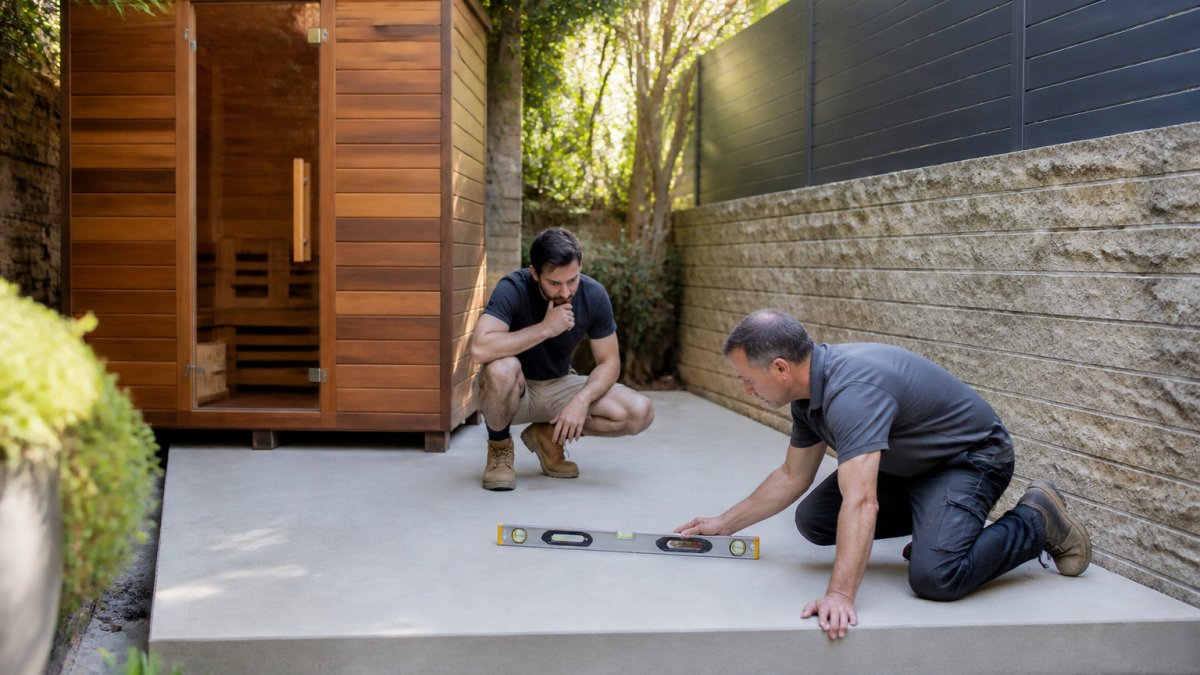
- Level ground. Outdoor units need a flat, stable base. A slight slope is fine for drainage, but the cabin itself must sit level.
- Ventilation. Infrared cabins are not sealed boxes; most have vents or a gap at the door. Leave space around the exterior so heat can dissipate and moisture does not trap against the wood.
Base and structure
- Concrete pad or deck. A poured concrete pad or a properly framed deck prevents settling and keeps the cabin off standing water. If you are pouring a pad, the same principles that apply to a pergola footing, level, cured concrete with adequate thickness, apply here.
- Weight. A filled two- or three-person cabin is heavy. If you are placing it on a deck, confirm the deck is rated for the combined cabin, occupant and water load.
- Drainage. Slope the pad or site so water moves away from the cabin, and keep the base clear of mulch and debris that hold moisture.
Weather exposure
Outdoor models are built for temperature extremes, but the wood still benefits from shade and from keeping the entrance out of standing water. A roof overhang, a pergola, or a spot against a windbreak extends the life of the benches and door seals.
Who does what
Most homeowners can handle the cabin assembly themselves with two people and a level. The electrical work and the base are the two jobs to hand to professionals. Budget for both before you compare cabin prices, the installation line item is often the difference between a project that fits the budget and one that does not.
National Fire Protection Association, NEC overview
Infrared Sauna Session Length and Maintenance for Longevity
Start with shorter sessions if you are new to heat, and hydrate before and after.
Upkeep is mostly about the wood and the electronics. Wipe benches and walls after each session, let the cabin air out to reduce moisture buildup, and check seals and door hinges each season. Keep the heater panels clean and dust-free, and inspect the wiring periodically. Follow the care guidance in the product listing for your specific model.
Booking Your Backyard Sauna Setup
A home infrared sauna is a practical addition to a backyard renovation when the electrical work, base and budget are settled before the unit arrives. Compare the three models above against your space and household size, confirm the power requirement with an electrician, and plan the base with the same care you would give a pergola footing.
When you are ready to choose a model, explore the full infrared sauna collection at Oasis Patio Direct and pick the size and finish that fits the retreat you want to create.
Frequently Asked Questions
Is there any real benefit to an infrared sauna?
Treat the sauna as a comfortable evening routine rather than a medical treatment, and check with a doctor first if you have heart conditions, are pregnant, or take medication that affects heat tolerance.
How long should you stay in an infrared sauna?
Drink water before and after, stop if you feel dizzy or unwell, and avoid long sessions immediately after intense exercise when your body is already overheated.
Should you shower after an infrared sauna?
A brief rinse or shower after a session helps remove sweat and any residue on your skin, and many users prefer to cool down gradually afterward. You do not need a hot shower, and drying off before getting dressed keeps you comfortable. Rehydrate with water, since the session causes significant fluid loss.
Are home infrared saunas worth the cost?
Oasis Patio Direct's listed outdoor infrared saunas include the Vexa Luxury 2-Person at $4,699.97 and the Vanta Luxury 3-Person at $6,499.97. Compare the price against how often you will use it, your available space, and the warranty. Home ownership makes the cost easier to justify for daily or weekly use than for occasional visits to a spa.