High Quality Outdoor Kitchen Components: 2026 Guide
Table of Contents
- What Makes Outdoor Kitchen Components High Quality
- Quick Comparison: Outdoor Kitchen Islands
- Weatherproof Outdoor Kitchen Cabinets and Storage
- Outdoor Kitchen Appliance Packages That Work Together
- Choosing Among the Best Outdoor Kitchen Brands
- Installation and Utility Requirements
- Conclusion
- Frequently Asked Questions
Last Updated: September 23, 2026
What Makes Outdoor Kitchen Components High Quality
High quality outdoor kitchen components are built from marine-grade 304 stainless steel, sealed against moisture, and engineered so every appliance in the suite works off the same utility plan. At Oasis Patio Direct, we see the same pattern in customer questions: buyers want to know whether a piece will survive five summers of intense sun, coastal salt air, or hard freezes.
Materials That Survive the Elements
304-grade stainless steel is the baseline for serious outdoor kitchens. It resists rust and corrosion far better than the painted steel used in budget patio furniture, which typically fails at weld points and hinges first.
Three material decisions matter most:
- Frame and body: 304 stainless steel, not powder-coated steel
- Countertop: granite or sealed stone that wipes clean and resists heat
- Hardware: stainless hinges, handles, and fasteners that won't pit
Quick Comparison: Outdoor Kitchen Islands
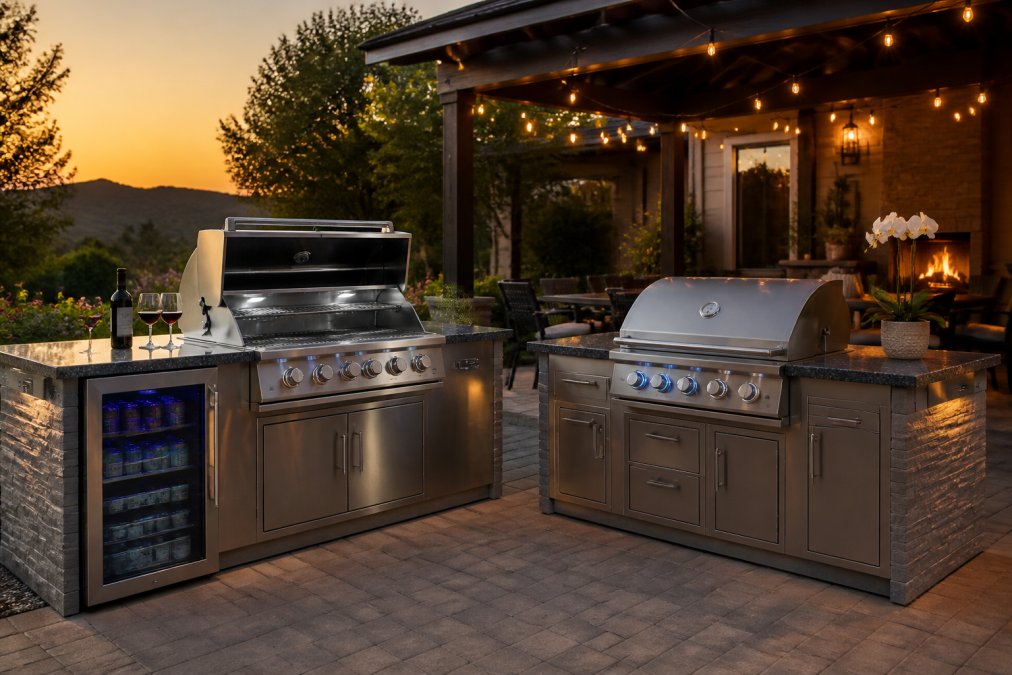
| Model | Burners / BTU | Cooling | Price |
|---|---|---|---|
| Verona 44-Inch (SAK97105) | 6 / 85K | Wine cooler | $6,199.97 |
| Avalon 43-Inch (SAK23864) | 6 / 85K | Wine fridge + sink | $5,899.97 |
| Astoria 94-Inch (SAK68014) | 6 / 85K | Wine cooler | $11,399.97 |
| Blaze 108-Inch (SAK58310) | 6 / 85K | Wine cooler | $11,999.97 |
| 128-Inch (SAK75770) | 6 / 120K | Refrigerator | $11,999.97 |
| 147-Inch (SAK96429) | 6 / 120K | 68L refrigerator | $12,999.97 |
Weatherproof Outdoor Kitchen Cabinets and Storage
Weatherproof outdoor kitchen cabinets use 304 stainless steel bodies with sealed doors and louvered or gasketed panels that let air move without letting water in. That airflow matters: a cabinet that traps humidity will rust from the inside out even when the exterior looks fine.

For storage, prioritize:
- Access doors for gas tanks and utility shutoffs
- Drawers on stainless glides, not plastic rollers
- Lockable compartments if your patio is exposed
Outdoor Kitchen Appliance Packages That Work Together
A matched outdoor kitchen appliance package pairs the grill, side burner, refrigeration, and ventilation on one utility plan. That matters because mismatched components create real problems: a refrigerator that needs a dedicated circuit the package didn't account for, a side burner that shares a gas line with the grill and starves it at peak demand, or a hood that can't keep up with a 120K BTU searing session.
What 'Matched' Actually Means
Three specs have to line up across every appliance in the suite:
- Gas pressure and orifice size: the grill, side burner, and pizza oven must all be set for the same fuel type and the same delivered pressure. A package built as a system ships with matching orifices; a mix-and-match build often does not.
- Electrical load: the refrigerator, lighting, and any ignition or rotisserie motor should be planned on the same circuit map so the total draw is known before the electrician runs conduit.
- Ventilation capacity: a hood or vent has to be sized against the grill's BTU output. A hood rated for a 60K BTU grill will not keep up with a 120K BTU searing session, and the smoke will find the nearest open window.
How to Evaluate a Package Before You Buy
A practical screen for any appliance package:
- Confirm 304 or 316 stainless on the frame, body, and hardware, not 'stainless steel' generically
- Confirm the grill, side burner, and pizza oven share one fuel type and one pressure spec
- Confirm the refrigerator's amperage and whether it needs a dedicated circuit
- Confirm the hood or vent is rated for the grill's total BTU output
- Confirm the countertop material and whether it is sealed for outdoor use
- Confirm assembly and delivery logistics, since a 147-inch island won't fit through a side gate
A Worked Example
The 150-Inch 4-Burner 108K BTU Island (SAK36412, $12,999.97) is the clearest example of a complete package in the current lineup. It bundles a gas grill, side burner, rotisserie, pizza oven, and a 68L wine cooler refrigerator with granite countertops and locking casters, and it arrives nearly fully assembled. Because the grill, side burner, and pizza oven are built to one gas spec and the refrigerator is planned on the same electrical map, the package avoids the two most common integration failures: a starved side burner and a fridge on a shared circuit.

Modular vs. Custom Packages
A modular package lets you start with a grill island and add a side burner, refrigerator, or bar module later. A custom package is built to one footprint from the start. Modular is the better fit if the patio layout may change or the budget is being staged; custom is the better fit if the footprint is fixed and the goal is one integrated countertop run.
Choosing Among the Best Outdoor Kitchen Brands
The best outdoor kitchen brands earn that label on three things: material grade, warranty terms, and whether the components are designed as a system. Brand reputation alone tells you little if the stainless is 430-grade and the hardware is zinc-plated.
A practical way to screen any brand:
150-Inch 4-Burner 108K BTU Outdoor →
- Confirm 304 or 316 stainless, not "stainless steel" generically
- Check whether the grill, burner, and fridge share one gas and electrical spec
- Ask about assembly and delivery, since a 147-inch island won't fit through a side gate
- Look for real customer photos, not studio renders
Installation and Utility Requirements
Most outdoor kitchen islands need three utilities planned before the crate ever arrives: a correctly sized gas line, a dedicated grounded electrical circuit, and a level, load-bearing pad with a drainage path. Skipping any one of the three produces the failures buyers complain about most, uneven burner flames, a refrigerator that won't hold temperature, and cabinets that warp after the first hard rain.
Gas Line Sizing
Gas appliances are rated in BTUs per hour, and the supply line has to carry the combined load of every burner running at once, not just the grill. A 120K BTU grill plus a 12K BTU side burner plus a 15K BTU pizza oven is a 147K BTU peak demand. A common pattern is to size the branch line for that total, not for the grill alone, because a line sized for the grill will starve the side burner when both are lit.
Two decisions drive everything downstream:
- Fuel type: liquid propane (LP) and natural gas (NG) require different orifices and different regulators. A grill set up for LP will not run correctly on NG without a conversion kit, and vice versa. Confirm the fuel type before ordering.
- Line diameter and run length: longer runs and smaller-diameter pipe reduce delivered pressure. A licensed gas fitter should confirm the pipe size against the total BTU load and the distance from the meter or tank.
Electrical Load and GFCI Protection
Refrigeration, lighting, and any rotisserie motor or ignition system draw power, and outdoor circuits have specific requirements. The National Electrical Code (NEC), published by the National Fire Protection Association (NFPA), requires ground-fault circuit-interrupter (GFCI) protection for outdoor receptacles, a detail that matters because a standard indoor circuit run to a patio is both a code problem and a shock hazard.
Plan for these loads:
- Refrigerator or wine cooler: a dedicated circuit is the safest approach. A compressor cycling on a shared circuit can trip a breaker when the grill igniter fires at the same time.
- Lighting and outlets: LED string lights and task lighting add little load, but they should still sit on a GFCI-protected circuit.
- Ignition and rotisserie motors: small draw, but they need a weather-rated connection point, not an indoor extension cord.
Surface, Weight, and Drainage
An outdoor kitchen island is heavy when loaded, a 147-inch island with granite countertops, a refrigerator, and a full propane tank can exceed what a bare patio slab or a wood deck was designed to carry. The pad has to be level, compacted, and rated for the loaded weight, or the frame will twist and the doors will stop closing squarely.
- Base: concrete or compacted paver base, not bare soil or loose gravel
- Level: a 1/8-inch-per-foot slope away from the house for surface water, but a level footprint under the island itself
- Drainage: if the island includes a sink, plan a drain line and a trap; a sink without a drain path is a bucket, not a sink
Utility Planning Checklist
- Confirm LP or NG, and confirm the grill, side burner, and pizza oven all match
- Size the gas branch line for the combined BTU load, not the grill alone
- Dedicated GFCI circuit for refrigeration; separate GFCI circuit for lighting
- Level, load-rated pad with a drainage path for any sink
- Licensed gas fitter and electrician sign off before the island is set in place
Getting these five items right before delivery is what separates a kitchen that works on day one from one that needs a second visit from a contractor.
Conclusion
The gap between a kitchen that lasts a decade and one that rusts in two years comes down to material grade, matched components, and correct utility planning. Oasis Patio Direct builds its outdoor kitchen components around 304 marine-grade stainless steel, granite countertops, and fully integrated suites that arrive nearly assembled. Explore the collection to find a configuration that fits your patio, your climate, and your hosting style.
Frequently Asked Questions
What is the best material for outdoor kitchen components?
304 marine-grade stainless steel is the standard for high quality outdoor kitchen components. It resists rust and corrosion better than 430-grade steel, which matters in humid or coastal climates. Granite countertops handle heat and weather without fading. Look for components that specify 304-grade stainless steel in the product listing.
Are stainless steel outdoor kitchen components worth the investment?
Stainless steel components cost more upfront but last years longer than painted steel or aluminum alternatives. A 304-grade stainless steel island resists rust, handles temperature swings, and wipes clean easily. If you plan to stay in your home for five or more years, the durability justifies the price.
What should I look for in outdoor kitchen appliance packages?
Check that every appliance in the package is rated for outdoor use. Look for built-in refrigerators with glass doors, grills with double-lined hoods for heat retention, and side burners for prep work. A package that includes matching storage cabinets and a rotisserie kit saves you from sourcing each piece separately.
How do I protect my outdoor kitchen components from the elements?
Choose weather-resistant materials like 304 stainless steel and granite from the start. Use a grill cover during extended periods of non-use. Wipe down stainless surfaces monthly to prevent water spots. In freezing climates, shut off and drain water lines to sinks and refrigerators before the first freeze.
How do I choose high quality outdoor kitchen appliances?
Start with BTU output: 72,000 to 120,000 BTUs handles most home cooking. Confirm the appliance is rated for outdoor use, not just indoor units placed outside. Check for 304 stainless steel construction and sealed burners. A double-lined hood and built-in temperature gauge signal better heat control.